
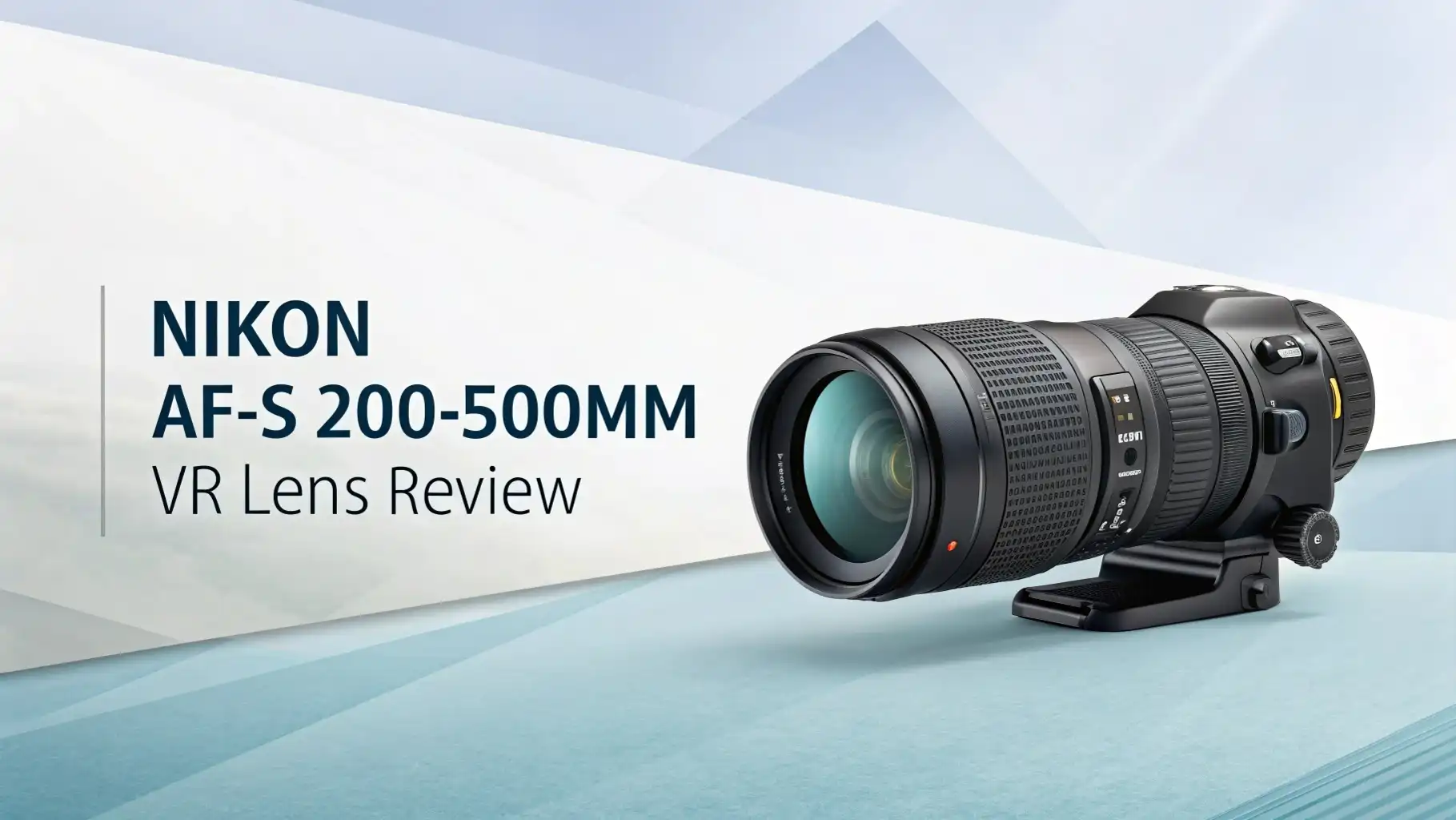
Nikon AF-S 200-500mm VR Lens Review:The Complete Guide
The world of super telephoto zoom lenses has always been expensive. Most wildlife and sports photographers dream of owning one but struggle with the hefty price tags. The Nikon AF-S 200-500mm f/5.6E ED VR lens changed this equation completely when it first arrived.
This lens brought professional level reach to enthusiast photographers without breaking the bank. Whether you want to photograph distant birds, capture fast moving athletes, or shoot wildlife from a safe distance, this lens promises to deliver. But does it really live up to the hype? After extensive testing and real world use, I am here to share everything you need to know about this popular super telephoto zoom lens.
This review will help you understand whether the Nikon 200-500mm VR deserves a place in your camera bag. You will discover its strengths, weaknesses, and how it performs in actual shooting conditions. I will also compare it with competing lenses and show you alternatives that might suit your needs better.

Key Takeaways
Fixed Aperture Throughout the Range: The lens maintains a constant f/5.6 aperture from 200mm to 500mm, which makes it easier to maintain consistent exposure settings when zooming in or out during your shoot.
Impressive Image Stabilization: With up to 4.5 stops of Vibration Reduction, you can shoot handheld at slower shutter speeds and still get sharp images, which proves invaluable when shooting in low light conditions or when a tripod is not practical.
Budget Friendly Super Telephoto Option: Priced significantly lower than professional super telephoto lenses while delivering excellent image quality, this lens opens up wildlife and sports photography to photographers who cannot afford lenses costing $10,000 or more.
Excellent Build Quality: The lens features weather sealing, a sturdy construction that can handle tough outdoor conditions, and smooth zoom operation that gives you confidence during field work.
Weight Consideration Required: At approximately 2300 grams (81 ounces), this lens demands good physical conditioning for handheld shooting and often works best with monopod or tripod support for extended sessions.
Understanding the Nikon AF-S 200-500mm VR Lens

- Compact super telephoto zoom lens for birding, wildlife, motorsports, events and more
- 500 millimeter of zoom power on fx format DSLR; 750 millimeter equivalent on dx format DSLRs, minimum focus distance: 7.2 feet ( 2.2 meter), focal...
- Fast f/5.6 constant aperture for beautiful out of focus backgrounds and low light performance
The Nikon AF-S 200-500mm f/5.6E ED VR represents a category of lenses that many photographers thought impossible to create at this price point. Nikon designed this super telephoto zoom to serve wildlife photographers, bird watchers, sports shooters, and anyone who needs serious reach without selling their car. The lens covers a focal length range from 200mm to 500mm, giving you a 2.5x zoom range that lets you adjust your composition without changing position.
What makes this lens special is its fixed f/5.6 maximum aperture. Most zoom lenses in this category use variable apertures, which means the maximum aperture gets smaller as you zoom in. The Nikon 200-500mm maintains f/5.6 throughout the entire zoom range. This consistency helps you maintain your exposure settings and makes the lens more predictable to use. You never need to worry about losing light when you zoom to 500mm.
The lens uses 19 elements arranged in 12 groups. Three of these elements are ED (Extra-low Dispersion) glass, which helps reduce chromatic aberration and improves overall sharpness. The optical formula delivers impressive image quality across the zoom range. Photographers consistently report sharp results, especially when shooting at f/8, which represents the sweet spot for this lens.
Build quality exceeds expectations for a lens in this price category. The lens barrel feels solid in your hands. Nikon included weather sealing at the lens mount, which provides protection against dust and moisture. The zoom ring operates smoothly with just the right amount of resistance. You can zoom quickly when needed but the ring will not creep when you point the lens up or down.
Optical Performance and Image Quality
Image quality stands as the most critical factor when evaluating any lens. The Nikon 200-500mm VR delivers excellent sharpness across most of its zoom range. At 200mm, the lens produces very sharp images right from f/5.6. You can shoot wide open with confidence. Sharpness remains strong at 300mm and 400mm. At 500mm, there is a slight reduction in sharpness compared to shorter focal lengths, but the results still satisfy most photographers.
The sweet spot sits at f/8. When you stop down to f/8, you get the absolute best sharpness this lens can produce. Many professional wildlife photographers shoot at f/8 or f/11 whenever light conditions allow. The improved depth of field at these apertures also helps ensure your subject stays sharp.
Chromatic aberration remains well controlled throughout the zoom range. The ED glass elements do their job effectively. You might see some color fringing in very high contrast situations, but these issues fix easily in post processing. Lateral chromatic aberration appears minimal, which means you spend less time fixing purple and green fringes in your images.
Contrast and color rendition both impress. Images straight out of camera show good contrast and punchy colors typical of Nikkor lenses. The lens handles backlit situations reasonably well, though you should use the included lens hood to minimize flare. When shooting directly into the sun or bright light sources, some ghosting can occur, but this proves true for most lenses in this category.
Vignetting appears moderate at f/5.6 across all focal lengths. You will notice darker corners when shooting wide open, particularly at 200mm. Stopping down to f/8 reduces vignetting significantly. Most photographers either correct this in post processing or embrace it as part of the look. The vignetting does not distract from the overall image quality.
Vibration Reduction System
The Vibration Reduction (VR) system in this lens deserves special attention. Nikon claims up to 4.5 stops of image stabilization. Real world testing confirms this claim holds true. Many photographers report getting sharp handheld shots at shutter speeds as slow as 1/30 second at 500mm. Without VR, you would need shutter speeds around 1/500 second for similar sharpness.
The VR system offers three modes. Normal mode works for general shooting and compensates for camera shake in all directions. Sport mode only activates VR when you press the shutter button, which helps you track moving subjects more smoothly. The third setting turns VR off completely, which you should use when shooting on a sturdy tripod.
You can hear and feel the VR system engage when you half press the shutter button. The lens makes a subtle humming sound and the viewfinder image stabilizes. This stabilization proves especially valuable when shooting wildlife in low light conditions. Early morning and late evening offer the best light for wildlife photography, but these times also challenge your ability to maintain fast shutter speeds.
The VR system excels at compensating for vertical and horizontal shake. It also handles the subtle movements that occur when you shoot handheld with heavy lenses. Many photographers successfully shoot this lens handheld for short periods thanks to the effective VR system. However, physical fatigue remains a factor with any lens weighing over 2 kilograms.
Battery consumption increases when using VR. The stabilization system draws power from your camera battery. You should carry extra batteries when planning extended shooting sessions with VR enabled. Some photographers turn off VR when shooting on tripods or monopods to conserve battery life, though Nikon claims the VR system should detect tripod use automatically.
Autofocus Speed and Accuracy
The autofocus system uses a Silent Wave Motor (SWM) that provides reasonably fast and quiet focusing. The lens focuses faster than the older 80-400mm VR but slower than professional super telephoto prime lenses. For wildlife photography, the autofocus speed proves adequate for most situations. You can track birds in flight and capture moving animals with good success rates.
Focus accuracy impresses more than focus speed. The lens consistently achieves sharp focus on your intended subject. Back focus and front focus issues appear rare. The lens works well with all autofocus modes, including single point AF, dynamic area AF, and 3D tracking. When paired with cameras like the D500 or D850, the autofocus system becomes even more capable.
The minimum focusing distance measures 2.2 meters (7.2 feet). This allows you to get reasonably close to your subjects while still maintaining the ability to focus. The maximum magnification ratio reaches 0.22x, which means you can capture decent sized images of smaller subjects when you get close. Some photographers use this lens for larger insects, flowers, and other subjects that do not require true macro capabilities.
Internal focusing means the lens does not extend or rotate when focusing. This feature provides several benefits. First, it maintains better balance during shooting. Second, it prevents the lens from becoming front heavy when focused on distant subjects. Third, it works better with circular polarizing filters, which require specific orientation.
Manual focus override works at any time without switching modes. You can adjust focus manually even while in autofocus mode. The focus ring operates smoothly with good resistance. The ring turns through approximately 180 degrees from minimum focusing distance to infinity. This gives you fine control over focus adjustments.
Top 3 Alternatives for Nikon AF-S 200-500mm VR

- 150-600mm F5-6.3 DG OS HSM / C
- Minimum focusing distance : 280 cm/110.2 inches, focal length :150-600mm. Diaphragm blades: 9
- First hyper-telephoto zoom from the Contemporary line, Dust proof and splash proof mount95mm filter
The Sigma 150-600mm f/5-6.3 DG OS HSM Contemporary offers more reach at the long end while starting wider at 150mm. This lens provides a 4x zoom range compared to the 2.5x range of the Nikon. The Sigma weighs slightly less and costs competitively. Image quality compares favorably, though the variable aperture means you lose light as you zoom in. The Sigma works well for photographers who want maximum versatility in a single lens.

- Builds upon the success of the original and much acclaimed SP 150-600mm A011
- Features a Faster AF speed, enhanced Vibration Compensation, and better overall optical performance
- eBAND and BBAR coatings further improve light transmission and suppress internal reflections. The maximum magnification ratio is 1:3.9
The Tamron SP 150-600mm f/5-6.3 Di VC USD G2 represents another strong competitor. This lens features excellent build quality, weather sealing, and impressive image stabilization. The G2 version brought significant improvements over the original model. The Tamron offers customization through its TAP-in console, allowing you to fine tune autofocus and other parameters. Image quality rivals the Nikon, and some photographers prefer the Tamron’s handling characteristics.

- Ease of use. At its widest setting, the NIKKOR Z 180-600 f/5.6-6.3 VR is great for locating your subject. With a mere 70° turn of the zoom ring, you...
- Handheld shooting. Built-in optical Vibration Reduction (VR) provides a stabilization effect equivalent to a shutter speed of 5.5 stops* faster,...
- Versatile close shooting. The lens features a minimum focus distance of 4.27 ft at the 180mm zoom position and a large 0.25x reproduction ratio, to...
The Nikon Z 180-600mm f/5.6-6.3 VR serves as the modern successor for Z-mount cameras. This lens works with Nikon’s mirrorless system and brings updated optics and faster autofocus. The 180-600mm offers more range at both ends of the zoom. It costs more than the 200-500mm but delivers improved performance in most areas. Z-mount users should consider this lens their first choice, while F-mount users might stick with the proven 200-500mm.
Build Quality and Weather Sealing
The lens construction feels solid and professional. Nikon used high quality plastics for the exterior barrel, which keeps weight manageable while maintaining strength. The lens does not feel cheap or fragile. You can handle it confidently in the field without worrying about durability issues.
Weather sealing protects the lens from dust and moisture. Nikon includes a rubber gasket at the lens mount, which creates a seal with your camera body. Additional sealing throughout the lens barrel helps keep internal elements protected. Many photographers use this lens in light rain, dusty conditions, and other challenging environments without problems.
The zoom ring requires moderate force to turn. This resistance prevents zoom creep, which occurs when gravity causes the lens to extend or retract on its own. You can point the lens at any angle without the zoom changing position. The zoom ring turns smoothly through the entire range. Some photographers prefer to zoom by pushing or pulling the lens barrel, but this lens uses a rotation only zoom mechanism.
The tripod collar rotates smoothly and locks securely in any position. You can quickly switch between horizontal and vertical orientations. The collar feels sturdy enough to support the lens safely. Some photographers replace the stock collar with third party alternatives that offer better balance or Arca-Swiss compatibility, but the included collar works well for most users.
The lens hood uses a bayonet mount and locks securely in place. The hood provides good protection from stray light and helps prevent flare. It also offers physical protection for the front element. The hood reverses for storage and transport. When reversed, it adds significant length to the lens, so you need to account for this when packing your gear.
Handling and Ergonomics
Carrying and shooting with a lens weighing 2.3 kilograms requires consideration. The weight becomes noticeable quickly when shooting handheld. Most photographers find they can handhold this lens for short periods, particularly when shooting with good technique and using the VR system. For extended sessions, a monopod or tripod becomes essential.
The lens balances reasonably well on most Nikon bodies. On full frame cameras like the D850 or D780, the weight distribution feels acceptable. On smaller DX bodies like the D500 or D7500, the lens feels more front heavy. You need to support the lens barrel with your left hand rather than supporting the camera body. This technique becomes natural after some practice.
The focus limiter switch helps speed up autofocus. You can choose between full range focusing or limiting focus to subjects from 6 meters to infinity. When shooting distant wildlife, using the limiter prevents the lens from hunting through the entire focus range. This small feature proves more useful than many photographers initially realize.
The VR mode switch sits in an accessible location on the lens barrel. You can change VR modes without taking your eye from the viewfinder. The autofocus manual focus switch also falls easily under your fingers. These controls feel solid and move with positive clicks, which helps you confirm switch positions by feel.
The lens includes four focus hold buttons positioned around the barrel. These buttons stop autofocus and hold focus at the current distance. This proves useful when you want to recompose after achieving focus. The buttons can also be reprogrammed on some camera bodies to perform other functions. Their placement around the barrel means you can access a button regardless of how you rotate the lens.
Performance with Different Camera Bodies
This lens works with all Nikon F mount cameras, but performance varies depending on the body. On DX (APS-C) cameras like the D500 or D7500, the effective focal length becomes 300-750mm. This extra reach proves beneficial for wildlife photography. The D500 particularly shines with this lens thanks to its excellent autofocus system, fast burst rate, and high ISO performance.
On FX (full frame) cameras like the D850, D780, or D6, you get the native 200-500mm focal length. Full frame bodies provide more resolution and better high ISO performance. The D850’s 45 megapixel sensor captures incredible detail when paired with this lens. You can crop images significantly and still maintain excellent quality.
The lens works with older camera bodies, though autofocus performance may suffer on cameras with less advanced autofocus systems. The lens requires a camera body with a built in autofocus motor is not necessary since this lens includes its own focusing motor. Any Nikon DSLR can autofocus with this lens.
Battery grip benefits become apparent when shooting with this lens. The extra weight of a battery grip helps balance the heavy lens. You also gain extended battery life, which proves valuable during long shooting sessions. The vertical shutter button makes shooting in portrait orientation more comfortable.
Using this lens with teleconverters produces mixed results. The lens works with both the TC-14E III (1.4x) and TC-20E III (2.0x) teleconverters. With the 1.4x TC, you get 280-700mm at f/8. Image quality remains good, though you lose some sharpness. Autofocus slows down and only works with cameras that support f/8 autofocus. The 2.0x TC gives you 400-1000mm at f/11, but image quality suffers noticeably and autofocus becomes very slow or unusable depending on your camera body.
Real World Wildlife Photography
Wildlife photography represents the primary use case for this lens. The 200-500mm range covers most wildlife situations. You can photograph large mammals at moderate distances, birds perched in trees, and even some bird in flight photography. The fixed f/5.6 aperture provides enough light for reasonable shutter speeds in good conditions.
Bird photography works well with this lens. You can capture perched birds with excellent detail. The 500mm focal length gets you close enough for frame filling shots of larger birds. For smaller songbirds, you might need to crop more aggressively or get physically closer. Bird in flight photography succeeds when conditions favor you. Fast flying birds in good light present no problems. Slower flying birds like herons and egrets become easier targets.
The lens excels at photographing larger mammals. Deer, elk, bears, and similar sized animals photograph beautifully. You can maintain safe distances while still capturing compelling images. The zoom range lets you adjust framing as animals move closer or farther away. This flexibility proves valuable when you cannot control your distance from subjects.
Safari photography represents an ideal use for this lens. The focal length range works perfectly for vehicle based wildlife viewing. You can photograph animals at various distances without changing lenses. The fixed aperture helps you maintain consistent settings as lighting conditions change. Many safari photographers choose this lens over more expensive alternatives.
The lens performs adequately in low light situations. The f/5.6 maximum aperture limits you somewhat compared to faster lenses. You need to raise ISO or slow shutter speeds in dim conditions. The VR system helps compensate for slower shutter speeds. Modern cameras with excellent high ISO performance pair well with this lens, allowing you to maintain fast enough shutter speeds to freeze action.
Sports and Action Photography
Sports photographers appreciate the 200-500mm focal length range for many applications. The lens works well for field sports like soccer, football, and lacrosse. You can capture action across the field without changing position. The fixed aperture maintains consistent exposure as you zoom in and out following the action.
The autofocus system tracks moving subjects reasonably well. You can follow athletes as they move toward or away from you. The focus tracking performance depends partly on your camera body’s autofocus capabilities. Newer bodies like the D500 or D850 deliver better results than older cameras.
Indoor sports photography challenges this lens. The f/5.6 maximum aperture requires very high ISO settings in typical gymnasium or arena lighting. You need a camera with excellent high ISO performance to achieve acceptable results. Outdoor daytime sports work much better, where you can maintain reasonable ISO settings and fast shutter speeds.
The 200mm short end provides enough width for closer action. You can photograph athletes at moderate distances without feeling too tight in your framing. The 500mm long end reaches distant action effectively. This zoom range covers most situations you encounter at sporting events.
The weight becomes a factor during sports photography. Shooting an entire game or match handheld proves tiring. Many sports photographers use monopods to support the lens while maintaining mobility. The monopod takes the weight off your arms while still allowing you to pan and track action smoothly.
Value Proposition and Price Comparison
The Nikon 200-500mm VR delivers exceptional value for money. When it launched, the lens disrupted the super telephoto market. Competing options either cost significantly more or offered inferior image quality. This lens brought professional level reach to enthusiast budgets.
Price considerations make this lens attractive. You get excellent optical performance, effective image stabilization, and solid build quality for a fraction of what professional super telephoto lenses cost. The value proposition becomes even stronger on the used market, where you can find excellent condition examples at reduced prices.
Compared to prime super telephoto lenses, the 200-500mm costs much less. A 500mm f/4 or 600mm f/4 prime lens costs several times more. Those lenses offer faster apertures, better build quality, and potentially superior optics, but they also weigh significantly more and cost tens of thousands of dollars. The 200-500mm gives you similar reach with the added benefit of zoom flexibility.
The zoom range adds tremendous value. With a prime lens, you must physically move to change your composition. The 2.5x zoom range of the 200-500mm lets you adjust framing instantly. This flexibility proves especially valuable when photographing wildlife, where you cannot always control your distance from subjects.
Long term value remains strong. This lens holds its value well in the used market. Many photographers keep this lens for years because it continues to perform well. The build quality ensures the lens survives regular use. Some photographers eventually upgrade to more expensive options, but many find the 200-500mm meets their needs indefinitely.
Limitations and Considerations
Every lens has limitations, and the 200-500mm proves no exception. Weight represents the most obvious limitation. At 2.3 kilograms, this lens demands physical fitness for handheld shooting. You need good technique and strong arms to shoot handheld for extended periods. Many photographers rely on monopods or tripods for support.
The f/5.6 maximum aperture limits performance in low light. You cannot achieve the shallow depth of field or fast shutter speeds that f/2.8 or f/4 lenses provide. In dim conditions, you must raise ISO or accept slower shutter speeds. The effective VR system helps somewhat, but physics still limits what you can achieve.
Autofocus speed, while adequate, does not match professional grade lenses. Sports photographers shooting fast action in challenging conditions might find the autofocus system frustrating. The lens performs better with predictable subject movement than with erratic action. This limitation matters more for professional photographers than enthusiasts.
The lens lacks Nano Crystal Coating, which Nikon uses on premium lenses to reduce flare and ghosting. When shooting in challenging light situations, particularly with the sun in the frame, you might see more flare than you would with better coated lenses. Using the lens hood helps minimize this issue.
Size presents practical challenges. The lens measures over 10 inches long and requires a large camera bag. You cannot pack this lens in a standard shoulder bag. You need dedicated space in a backpack or a specialized lens bag. Travel becomes more complicated when you carry this lens.
Accessories and Recommendations
Several accessories enhance your experience with this lens. A quality tripod or monopod becomes essential for serious work. Look for tripods rated to support at least 3-4 kilograms. The tripod head matters as much as the tripod itself. Ball heads work for static subjects, while gimbal heads excel for tracking moving wildlife.
A lens pouch or bag protects your investment during transport. The lens ships with a soft case, but upgrading to a padded lens pouch provides better protection. Some photographers prefer keeping the lens in a dedicated bag while others pack it in their camera backpack with other gear.
A sturdy camera strap helps when carrying the lens with camera attached. A wider strap distributes weight more comfortably across your shoulder or neck. Some photographers prefer using a Black Rapid style strap that lets the camera hang at their side rather than from their neck.
Extra batteries prove necessary for extended shooting sessions. The VR system and continuous autofocus drain batteries faster than normal shooting. Carrying two or three spare batteries ensures you never miss shots due to dead batteries. Consider investing in genuine Nikon batteries rather than third party alternatives for best performance.
A circular polarizing filter can enhance your images. The front element accepts 95mm filters, which cost more than smaller filters. A polarizing filter reduces reflections, increases color saturation, and can darken skies. The filter adds one stop of light loss, so use it only when the effect benefits your image.
Maintenance and Care
Proper maintenance extends the life of your lens. Regular cleaning keeps the optics performing optimally. Use a rocket blower to remove loose dust from the front and rear elements. For stubborn dirt, use lens cleaning solution and microfiber cloths specifically designed for camera lenses. Clean the front element carefully, as the coating can scratch if you use too much pressure.
Store the lens in a dry environment when not in use. Moisture encourages fungus growth, which can permanently damage lens elements. Use silica gel packets in your camera bag to absorb moisture. In humid climates, consider storing lenses in a dry cabinet designed for camera equipment.
Check the weather sealing periodically. The rubber gasket at the lens mount can wear out over time. If you shoot frequently in dusty or wet conditions, inspect the gasket annually and replace it if necessary. Nikon service centers can replace gaskets relatively inexpensively.
The zoom mechanism requires occasional attention. If you notice the zoom ring becoming stiff or loose, the internal lubricants might need refreshing. Do not attempt to disassemble the lens yourself. Take it to an authorized Nikon service center for professional maintenance. Regular professional cleaning and adjustment every few years keeps the lens operating smoothly.
Protect the lens during transport. Remove the lens from the camera body when traveling. Store it in a padded bag or compartment where it cannot bang against other equipment. The front and rear lens caps should always be in place when the lens is not mounted on a camera. The lens hood provides additional protection for the front element.
Shooting Tips and Techniques
Successful shooting with this lens requires good technique. Support the lens properly by holding the lens barrel with your left hand, not the camera body. This technique provides better balance and reduces strain. Keep your elbows tucked against your body for additional stability. Stand with feet shoulder width apart and slightly stagger your stance for better balance.
Use the fastest shutter speed conditions allow. A general rule suggests using a shutter speed of 1 over focal length as a minimum. At 500mm, this means 1/500 second without VR. With VR active, you can often succeed with 1/125 second or even slower, but faster remains better for capturing sharp images.
Shoot in bursts when photographing wildlife or sports. Modern cameras can capture multiple frames per second. Taking several shots in quick succession increases your chances of capturing the perfect moment. You can delete the misses later, but you cannot recover missed moments.
Watch your backgrounds. The long focal length compresses perspective and throws backgrounds beautifully out of focus. However, busy backgrounds can still distract from your subject. Try to position yourself so your subject stands against a clean, uncluttered background. Moving a few steps left or right often improves background separation dramatically.
Experiment with different apertures. While f/8 delivers maximum sharpness, shooting wide open at f/5.6 provides more background blur. The choice depends on your creative vision and the situation. For single animals or birds, f/5.6 or f/6.3 works well. For groups of animals, stopping down to f/8 or f/11 ensures everyone stays sharp.
Firmware Updates and Technical Support
Nikon occasionally releases firmware updates for this lens. These updates can improve autofocus performance, fix bugs, or add compatibility with newer camera bodies. Check the Nikon website periodically for available updates. You need a computer and a compatible camera body to install lens firmware updates.
Nikon’s warranty covers defects in materials and workmanship for five years from the date of purchase. Register your lens with Nikon after purchasing to ensure warranty coverage. Keep your purchase receipt as proof of purchase date. The warranty covers repairs but not damage from accidents or misuse.
If you experience problems with your lens, contact Nikon customer support or visit an authorized service center. Common issues include autofocus problems, zoom ring stiffness, and VR system failures. Many problems can be resolved through professional service. Attempting repairs yourself voids the warranty and risks causing additional damage.
Third party repair services cost less than authorized Nikon service but may void your warranty. Some independent repair shops specialize in camera equipment and deliver excellent results. However, they cannot access proprietary Nikon parts or technical documentation. For warranty covered repairs, always use authorized service centers.
Online forums and communities provide valuable troubleshooting help. Many experienced photographers share solutions to common problems. Before sending your lens for service, search online to see if others have experienced and solved similar issues. Sometimes simple fixes like cleaning contacts or adjusting autofocus micro-adjustment resolve apparent problems.
Environmental Considerations
The Nikon 200-500mm VR performs well across a range of temperatures. Cold weather requires some special consideration. Batteries drain faster in cold conditions, so keep spares warm in an inner pocket. The VR system might take slightly longer to activate in extreme cold. Allow the lens to acclimate gradually when bringing it from very cold to warm environments to prevent condensation.
Hot weather rarely causes problems with this lens. However, extreme heat can affect autofocus accuracy and cause the lens barrel to expand slightly. Store the lens in shade when possible during hot days. Never leave your lens in a closed car on hot days, as temperatures inside vehicles can damage electronic components and lubricants.
Humidity challenges all camera equipment. In very humid environments, store your lens with desiccant packets to prevent moisture buildup. If condensation forms on the lens, allow it to dry naturally in a well ventilated area. Do not use external heat sources, which can damage internal components or coatings.
Dusty environments require extra care despite the weather sealing. Change lenses only in protected areas when possible. Keep both lens caps on when the lens is not in use. Clean the lens more frequently when shooting in dusty conditions. The weather sealing protects against dust infiltration but does not make the lens completely dustproof.
Rain and moisture pose manageable risks thanks to the weather sealing. Many photographers shoot in light rain without problems. Use a rain cover for heavy rain or extended exposure to moisture. Dry the lens exterior thoroughly after exposure to rain. Check the lens mount gasket periodically to ensure it remains in good condition.
Frequently Asked Questions
Does the Nikon 200-500mm VR work with teleconverters?
Yes, this lens works with both the Nikon TC-14E III (1.4x) and TC-20E III (2.0x) teleconverters. With the 1.4x TC, you get 280-700mm at f/8 with acceptable image quality and autofocus on cameras that support f/8 AF. The 2.0x TC provides 400-1000mm at f/11, but image quality decreases noticeably and autofocus becomes very slow or stops working on many cameras.
Can I shoot handheld with this lens?
You can shoot handheld for short periods, particularly with good technique and the VR system enabled. The 2.3 kilogram weight becomes tiring quickly. Most photographers find a monopod or tripod necessary for extended shooting sessions. Your physical fitness and shooting technique significantly affect how long you can comfortably handhold this lens.
How does this lens compare to the Sigma 150-600mm Contemporary?
Both lenses deliver excellent image quality for their price points. The Nikon maintains a fixed f/5.6 aperture while the Sigma uses a variable f/5-6.3 aperture. The Sigma offers more zoom range (4x versus 2.5x) and reaches 600mm at the long end. The Nikon generally focuses slightly faster and works seamlessly with Nikon bodies. The Sigma costs competitively and weighs marginally less.
Is this lens suitable for beginner photographers?
This lens can work for beginners interested in wildlife or sports photography, but it presents challenges. The weight, size, and handling characteristics require some experience to manage effectively. Beginners might find a lighter, shorter telephoto lens easier to learn with initially. However, if wildlife photography represents your primary interest, this lens can serve you from beginner through advanced levels.
What cameras work best with the Nikon 200-500mm VR?
The lens works with all Nikon F-mount cameras. For best results, pair it with bodies featuring advanced autofocus systems like the D500, D850, D6, or D780. The D500 particularly excels thanks to its crop sensor (providing extra reach), fast burst rate, excellent autofocus, and high ISO performance. Full frame bodies like the D850 offer higher resolution for cropping flexibility.
How sharp is this lens at 500mm?
The lens delivers very good sharpness at 500mm, though slightly less than at shorter focal lengths. At f/5.6, the wide open aperture at 500mm, sharpness remains quite good. Stopping down to f/8 provides the best sharpness. The center of the frame shows excellent detail, while corner sharpness decreases slightly. For most wildlife photography, the sharpness at 500mm exceeds expectations.
Does this lens have problems with chromatic aberration?
Chromatic aberration remains well controlled thanks to the three ED glass elements. Some color fringing appears in very high contrast situations, but these issues fix easily in post processing software. Lateral chromatic aberration appears minimal across the zoom range. Overall, chromatic aberration poses less of an issue with this lens compared to many competing options.
What size camera bag do I need for this lens?
The lens measures approximately 267.5mm (10.5 inches) long with a maximum diameter of 108mm. You need a camera bag with a compartment at least 11-12 inches deep to accommodate the lens. Many photographers choose backpacks with dedicated super telephoto lens compartments or use roller cases for travel. Some photographers carry this lens in a dedicated lens bag separate from their main camera bag.

Kashvi is a passionate bird enthusiast and nature lover who has been fascinated by the world of birds for years. With a keen eye for detail and a love for learning, Kashvi is dedicated to sharing her knowledge and insights with fellow bird enthusiasts on Avian Enthusiasts. Through her engaging and informative articles, Kashvi aims to inspire others to join her in exploring the fascinating world of birds and to promote a deeper appreciation for these incredible creatures.

