
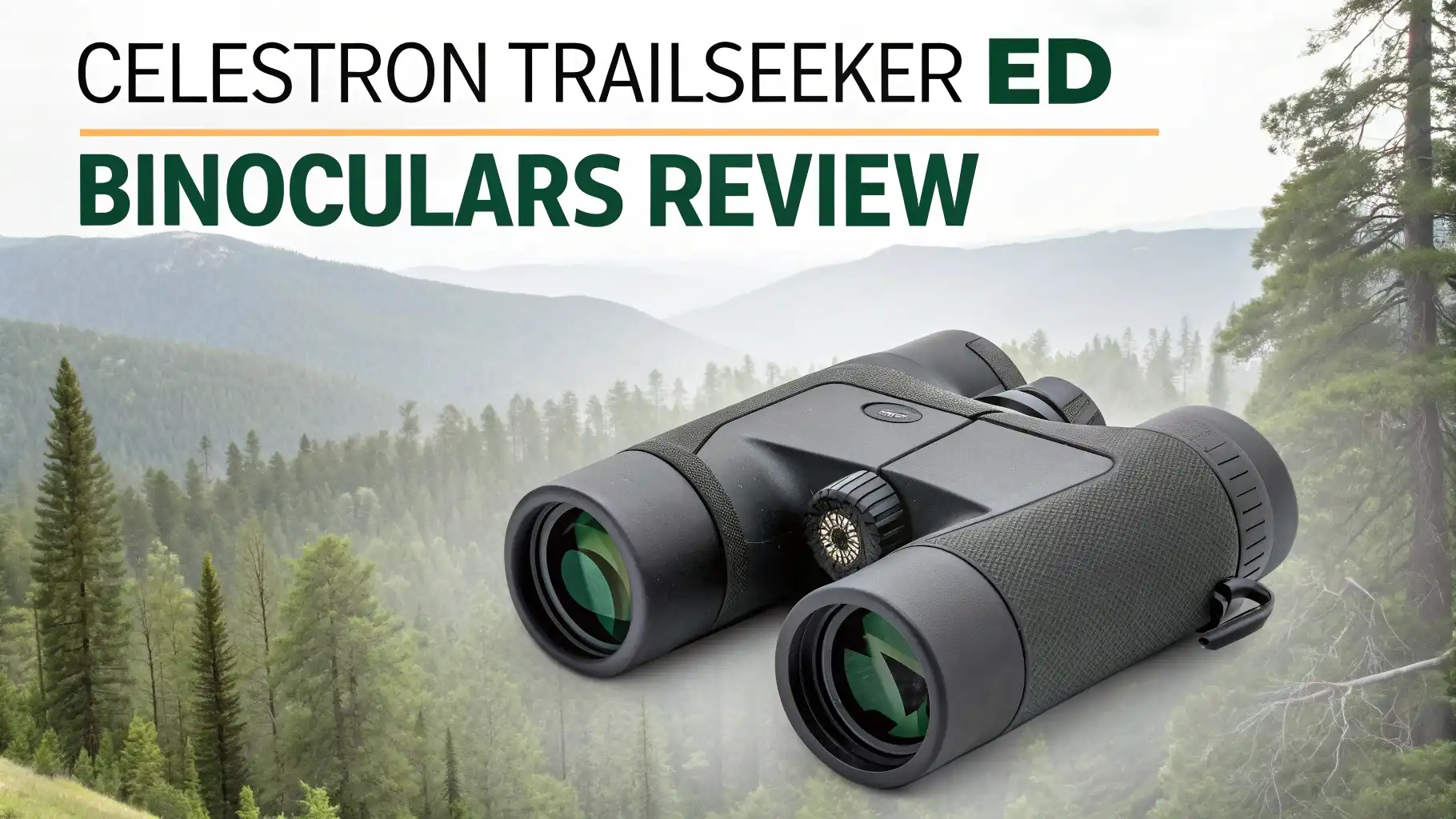
Celestron TrailSeeker ED Binoculars Review 2026
Are you searching for binoculars that deliver exceptional clarity without breaking the bank? The Celestron TrailSeeker ED series has captured attention across the birding and outdoor community. These binoculars promise professional-grade optics at a fraction of premium prices.
But do they truly deliver on this promise? This complete review explores every aspect of the TrailSeeker ED line. You will discover whether these binoculars match your outdoor viewing needs. We tested these optics extensively across multiple environments. Read on to find out if the TrailSeeker ED deserves a place in your gear collection.
Key Takeaways
Before diving deep into this review, here are the essential points you need to know about the Celestron TrailSeeker ED binoculars:
Extra-low dispersion (ED) glass eliminates color fringing and delivers crisp, sharp images across the entire field of view. This premium glass technology normally appears only in binoculars costing significantly more.
The wide field of view (426 feet at 1,000 yards for 8×42 model) makes tracking fast-moving birds and wildlife incredibly easy. You will appreciate this feature during active birding sessions.
Close focus distance of just 6.5 feet allows detailed observation of butterflies, flowers, and other nearby subjects. Most competing binoculars cannot focus this close.
Dielectric-coated and phase-corrected BaK-4 prisms maximize light transmission and image brightness. These professional-grade coatings create vivid, high-contrast views even in challenging light conditions.
The price point of approximately $295 for the 8×42 model positions these binoculars as exceptional value. You get features typically found in binoculars priced between $500 and $1,000.
Understanding the Celestron TrailSeeker ED Series

- PREMIUM ED OBJECTIVE LENSES: Extra-Low Dispersion (ED) glass virtually eliminates chromatic aberration or color fringing, a visual defect common in...
- PHASE-COATED BaK-4 PRISMS FOR BRIGHTER VIEWS: The prisms inside TrailSeeker ED feature quality BaK-4 glass with phase coatings that maximize light...
- DURABLE, WATERPROOF BODY: A rubber-armored, polycarbonate housing protects your binoculars from damage and stands up to the toughest weather...
The Celestron TrailSeeker ED family includes multiple configurations to suit different viewing preferences. The line offers both 8×42 and 10×42 full-size models, plus compact 8×32 and 10×32 versions. Each model shares core optical technologies while addressing specific user needs.
The ED glass objective lenses represent the standout feature across all models. This special glass minimizes chromatic aberration. You see true colors without purple or yellow fringing around high-contrast edges. The magnesium alloy chassis keeps weight manageable while maintaining structural integrity. The open-bridge design provides a comfortable grip during extended viewing sessions. These construction choices show Celestron’s commitment to balancing performance with usability.
The 8×42 configuration delivers the widest field of view in the series. This makes it ideal for bird watching, nature observation, and general outdoor use. The 10×42 version offers more magnification for distant subjects. Both models use identical optical coatings and prism systems. Your choice between them depends primarily on your viewing priorities and hand steadiness.
Optical Performance That Punches Above Its Weight
The optical quality of TrailSeeker ED binoculars consistently impresses reviewers and users. The fully multi-coated lens surfaces maximize light transmission through the optical path. Every air-to-glass surface receives anti-reflection coatings. This reduces light loss and increases image brightness.
The BaK-4 prism glass provides superior light transmission compared to cheaper BK-7 prisms. You notice the difference immediately when viewing in dim light conditions. The prisms also receive dielectric coatings rather than standard aluminum coatings. This advanced coating system reflects more than 99% of incoming light. The result is bright, vivid images with excellent color fidelity.
Phase correction coatings on the prism surfaces eliminate interference effects. These coatings ensure light waves remain in proper alignment as they pass through the prism system. The practical result? You see sharper, more detailed images with better contrast. This technology usually appears only in premium binoculars. Celestron includes it as standard in the TrailSeeker ED line.
Field testing reveals impressive edge-to-edge sharpness. The center of the view delivers tack-sharp focus, as expected. More remarkably, the image remains sharp almost to the edge of the field. Some minor softening appears in the outermost 10% of the field. This performance matches or exceeds many binoculars costing twice as much.
Build Quality and Weather Protection
The magnesium alloy chassis forms the backbone of TrailSeeker ED construction. This material offers excellent strength while keeping overall weight reasonable. The 8×42 model weighs approximately 24 ounces. This makes it light enough for all-day carry without causing fatigue. Yet it feels solid and substantial in your hands.
Rubber armor covers the exterior surfaces. This protective layer serves multiple purposes. It provides a secure, non-slip grip even in wet conditions. The rubber also absorbs minor impacts and protects the internal components. The texture feels comfortable during extended use. The armor maintains its integrity even after years of regular outdoor use.
The binoculars feature fully waterproof construction. All openings are sealed with O-rings to prevent moisture intrusion. You can use these binoculars in rain or snow without concern. The housing will even survive brief submersion if accidentally dropped in water. Nitrogen purging eliminates internal moisture and prevents fogging. The optical tubes remain fog-free even during rapid temperature changes.
The twist-up eyecups provide good adjustability for eyeglass wearers and bare-eyed users. The eyecups lock firmly at multiple intermediate positions. They do not creep down during use. The eye relief measures approximately 17mm. This proves adequate for most eyeglass wearers to see the full field of view.
Focus System and Ease of Use
The center focus wheel operates smoothly through its full range. It requires approximately 1.5 turns from close focus to infinity. This provides a good balance between speed and precision. You can make quick adjustments to track moving subjects. Yet the system offers fine control for critical focusing on distant birds.
The focus wheel features good tactile feedback. You feel positive resistance as you turn the wheel. It does not spin too freely or require excessive force. The large diameter and raised rubber grip make it easy to operate. You can adjust focus accurately even while wearing gloves.
Close focus distance ranks among the best features of TrailSeeker ED binoculars. The 8×42 model focuses down to just 6.5 feet. The 10×42 version focuses to 8.2 feet. These short minimum focus distances open up new viewing possibilities. You can observe butterflies, flowers, and other close subjects in stunning detail. Many competing binoculars cannot focus closer than 10 or 15 feet.
The diopter adjustment ring on the right eyepiece allows you to compensate for vision differences between your eyes. The ring moves smoothly and locks firmly once set. You will not need to readjust it unless someone else uses your binoculars. Clear markings help you remember your preferred setting.
Field of View Advantages
The TrailSeeker ED 8×42 delivers a true field of view of 7.3 degrees. This translates to 426 feet at 1,000 yards. This exceptionally wide view makes it easy to locate and track birds and wildlife. You spend less time searching and more time observing. The wide field also creates a more immersive viewing experience.
This field width exceeds most competitors in the same class. The Nikon Monarch 5 8×42 offers 330 feet at 1,000 yards. The Vortex Diamondback HD 8×42 provides 426 feet, matching the Celestron. Few binoculars in this price range deliver such generous fields of view.
The wide field proves particularly valuable during active birding. When a bird flushes from cover, you can follow its flight path more easily. Group birding becomes more enjoyable when you can direct others to interesting sightings. Beginning birders especially appreciate the forgiving nature of wide-field binoculars.
The 10×42 model naturally offers a narrower field due to higher magnification. It provides 341 feet at 1,000 yards. This still ranks very well for a 10x binocular. The field remains wide enough for comfortable wildlife observation. You gain the benefit of extra magnification without excessive field restriction.
Top 3 Alternatives for Celestron TrailSeeker ED
If you are considering the Celestron TrailSeeker ED, you should also evaluate these excellent alternatives in the same price range:

- 8x magnification & 42mm objective lenses, these Diamondback HD binos are optimized with select glass elements to deliver exceptional resolution, cut...
- Fully multi-coated lenses increase light transmission with anti-reflective coatings on all air-to-glass surfaces. Dielectric coating provides bright,...
- Adjustable eyecups twist up and down for comfortable viewing with or without eyeglasses. Center focus wheel adjusts the focus of both binocular...

- PREMIUM OPTICS WITH ED GLASS - Nikon MONARCH M5 binoculars feature Extra-low Dispersion (ED) glass lenses that minimize chromatic aberration and color...
- BRIGHT & NATURAL VIEW IN ANY LIGHT - Dielectric high-reflective multilayer prism coatings enhance light transmission for brighter, more natural...
- WIDE FIELD OF VIEW & SMOOTH FOCUSING - The MONARCH M5 high-definition binoculars offer a broad field of view for tracking birds, wildlife, or...

- ED Glass - ED glass gives you an image with little or no chromatic fringe so the final result brings a clearer and sharper image to your eyes
- ESP Dielectric Coating is a multi layer prism coating that reflects over 99% of the light to your eyes bringing you a clear, bright image that...
- Advanced FMC - Advanced Fully Multi-Coated lenses gives you better light transmission to bring optimum brightness and true color across the entire...
Comparing 8×42 vs 10×42 Models
The 8×42 configuration offers several advantages for general outdoor use. The wider field of view helps with bird identification and tracking. The lower magnification creates a steadier image when handholding. The brighter exit pupil (5.25mm) performs better in dim light. Most birders and wildlife watchers prefer 8x magnification for these reasons.
The 10×42 model serves specific situations better. Distant subjects appear larger and show more detail. Waterfowl identification across large bodies of water becomes easier. The extra magnification helps when observing from a fixed position. However, the narrower field (341 feet vs 426 feet) makes initial subject acquisition slower. The image also shows more shake from hand movement.
Image brightness differs slightly between the two models. The 8×42 produces an exit pupil of 5.25mm. The 10×42 generates a 4.2mm exit pupil. In good light, you will not notice this difference. In dawn, dusk, or deep shade, the 8×42 delivers a marginally brighter view. For most users in most conditions, both models provide ample brightness.
Your physical stability should influence your choice. If you can hold binoculars very steady, the 10x magnification works well. If you struggle with hand shake or view while walking, stick with 8x magnification. The steadier image makes viewing more comfortable during extended sessions.
Color Accuracy and Contrast
The ED glass elements deliver excellent color accuracy. Colors appear natural and true to life. You see subtle plumage variations that help identify similar species. The blue in a Bluebird’s back shows distinct from the blue-gray of a Blue Jay. These color nuances matter when distinguishing between species.
Contrast levels impress across various lighting conditions. Birds show clear separation from foliage backgrounds. You can pick out details in shadowed areas while simultaneously viewing bright sunlit regions. The high-quality optical coatings maintain contrast even when pointing near the sun.
Chromatic aberration remains well-controlled throughout most of the field. The ED glass effectively corrects color fringing. You might notice slight purple fringing on high-contrast subjects at the extreme edge of the field. In the central 80% of the view, chromatic aberration is virtually absent. This performance matches binoculars costing significantly more.
Glare resistance proves adequate for most situations. The fully multi-coated optics handle strong side lighting reasonably well. Viewing into low-angle morning or evening sun does produce some loss of contrast. This affects all binoculars to some degree. The TrailSeeker ED handles glare as well as most competitors in its class.
Comfort and Ergonomics
The open-bridge body design creates a comfortable grip for most hand sizes. Your fingers wrap naturally around the bridge section. This design distributes weight evenly and reduces hand fatigue. The shape feels more secure than traditional straight-barrel designs. You can hold these binoculars steady with one hand when needed.
The weight distribution balances well between the eyepiece and objective ends. The binoculars do not feel front-heavy or back-heavy. This balance contributes to comfortable extended viewing. You can glass for hours without developing arm strain. The 24-ounce weight sits in the sweet spot for full-size binoculars.
Interpupillary distance adjusts from 56mm to 74mm. This range accommodates the vast majority of users. The barrels move smoothly through the adjustment range. They lock firmly at any position without creeping. Even users with narrow or wide-set eyes should achieve proper alignment.
The neck strap attachment points use standard metal posts. The included neck strap works adequately but feels basic. Most users will want to upgrade to a more comfortable strap for all-day use. A padded neoprene strap or harness system significantly improves carrying comfort.
Performance in Different Lighting Conditions
Bright daylight brings out the best in TrailSeeker ED optics. Images appear crisp, bright, and colorful. Fine details resolve clearly even at distance. The wide field of view and comfortable ergonomics make extended viewing sessions pleasant. You will enjoy using these binoculars during midday bird walks.
Overcast conditions slightly reduce overall brightness, as with all binoculars. However, the TrailSeeker ED maintains good image quality. Colors remain saturated despite reduced light. The high-quality coatings and large exit pupil help maintain usable brightness. You can continue effective wildlife observation throughout gray, cloudy days.
Dawn and dusk viewing reveals the benefits of quality optics. The 8×42 model performs particularly well during magic hour. The 5.25mm exit pupil delivers ample light to your eyes. You can continue birding effectively during the critical first and last light periods. The 10×42 model also performs well, though the smaller exit pupil (4.2mm) shows slightly less brightness.
Deep shade and forest interiors test any binocular’s capabilities. The TrailSeeker ED handles these conditions better than many competitors. The combination of ED glass, dielectric coatings, and quality prisms maximizes available light. You can identify birds in shadowed understory where lesser binoculars show only silhouettes. This capability proves valuable in dense forest environments.
Real World Applications
Birding represents the primary use case where TrailSeeker ED binoculars excel. The wide field of view helps locate small, fast-moving birds. The close focus allows detailed observation of nearby subjects. The color accuracy helps distinguish between similar species. Many serious birders use these as their primary binoculars. Others employ them as excellent backup optics.
Wildlife observation benefits from the same features that serve birders well. The 10×42 model works particularly well for mammal watching. Deer, elk, and other large animals often require observation at greater distances. The extra magnification shows behavioral details and helps with species identification. The waterproof construction handles morning dew and unexpected rain.
Hiking and general outdoor use suits the TrailSeeker ED nicely. The moderate weight does not burden you during long trail days. The rugged construction survives the inevitable bumps and drops. You can glass distant peaks, spot wildlife, or simply enjoy scenic views. The close focus even allows examination of wildflowers and insects along the trail.
Astronomy applications work reasonably well with these binoculars. The 8×42 configuration shows wide fields of stars and constellations. You can observe the moon in excellent detail. Star clusters like the Pleiades appear beautiful. The 10×42 model provides better lunar detail and can resolve more distant objects. However, dedicated astronomy binoculars typically offer higher magnification.
Value Proposition Analysis
The TrailSeeker ED 8×42 typically sells for around $295. This positions it in the middle of the binocular market. You pay more than budget models but far less than premium alpha binoculars. The optical performance rivals binoculars costing $500 to $800. Few binoculars at this price point offer ED glass and fully dielectric coatings.
Direct competitors include the Vortex Diamondback HD ($197), Nikon Monarch M5 ($280), and Athlon Midas ED ($190). Each offers similar specification sheets. Real-world performance differences prove subtle. The Celestron holds its own against these respected alternatives. Some reviewers rank it at the top of this competitive group.
The build quality and features justify the asking price. You receive a magnesium chassis, not plastic. The optical coatings represent professional specifications. The included accessories (case, strap, lens covers) match or exceed what competitors provide. The overall package delivers strong value for the investment.
Long-term ownership costs remain minimal. These binoculars require no special maintenance beyond occasional cleaning. The durable construction should provide many years of reliable service. Celestron’s reputation for customer service adds peace of mind. If issues arise, the company typically responds quickly and fairly.
Accessories and Included Items
The included case provides adequate protection for storage and transport. The soft case features a padded interior and secure closure. It fits the binoculars snugly without excess bulk. However, the case does not offer hard-shell protection. Consider a hard case if you travel frequently or need maximum protection.
Lens covers include both objective caps and a rainguard. The objective caps attach with flexible straps to prevent loss. The rainguard covers both eyepieces and hangs from the neck strap. These covers work adequately but feel somewhat flimsy. Aftermarket covers from companies like Vortex or Swarovski fit and offer better quality.
The neck strap follows standard design with basic padding. It functions but does not provide exceptional comfort. During long viewing sessions, neck and shoulder fatigue may develop. Upgrading to a high-quality padded strap or binocular harness significantly improves comfort. This relatively inexpensive upgrade makes sense for serious users.
Lens cleaning supplies are not included. You should acquire a lens pen and microfiber cloth. Keep these items with your binoculars for field cleaning. Avoid using clothing or tissues on optical surfaces. These materials can scratch lens coatings. Proper cleaning tools maintain optimal optical performance.
Maintenance and Care Tips
Cleaning the optics requires gentle techniques and proper materials. Use a lens pen or air blower to remove loose particles. Never rub lenses when dry particles are present. Apply lens cleaning solution to a microfiber cloth, not directly to lenses. Wipe gently using circular motions. Clean lenses only when necessary to minimize wear on coatings.
Body maintenance involves periodic inspection and cleaning. Wipe down the rubber armor with a damp cloth to remove dirt and oils. Check that twist-up eyecups operate smoothly. Verify that the focus wheel moves freely without grinding or catching. Address any issues promptly to prevent further damage.
Storage practices significantly affect long-term performance. Store binoculars in their case when not in use. Keep them in a cool, dry location away from direct sunlight. Avoid leaving them in hot vehicles. Extreme temperatures and humidity can damage internal components over time. If storing for extended periods, add silica gel packets to absorb moisture.
Regular inspection helps catch problems early. Check lens surfaces for fungus growth, especially in humid climates. Examine the body for cracks or damage. Test the focus mechanism periodically. Verify that nitrogen purging remains effective by checking for internal fogging. Address any issues promptly through Celestron’s service department.
Common Issues and Solutions
Collimation problems sometimes occur with binoculars during shipping or after impacts. If you see double images or experience eyestrain, the barrels may be misaligned. This requires professional service. Attempting home repairs usually makes matters worse. Contact Celestron for warranty service or repair options.
Focus stiffness can develop over time or in cold weather. If the focus wheel becomes difficult to turn, do not force it. The issue may resolve as internal lubricants warm. Persistent stiffness requires professional service. Never attempt to disassemble the focus mechanism yourself.
Eyecup looseness occasionally develops with heavy use. The twist-up mechanism may not lock firmly at desired positions. This usually indicates worn detent mechanisms. Some users successfully tighten loose eyecups. However, this requires careful disassembly. Consider professional repair if the problem affects viewing comfort.
Moisture inside optical tubes suggests failed seals despite waterproof construction. This rare problem requires immediate attention. Do not attempt to dry the interior yourself. Contact Celestron for warranty service. The unit will need professional resealing and nitrogen purging.
Long Term Ownership Experience
Users report excellent durability over multiple years of regular use. The binoculars maintain optical performance despite extensive field use. The rubber armor shows some wear but continues protecting internal components. The focus mechanism remains smooth even after thousands of adjustments. Many owners report five or more years of trouble-free service.
Optical performance remains stable over time. Lens coatings maintain their effectiveness with proper care. Image quality does not degrade noticeably over normal ownership periods. The ED glass continues controlling chromatic aberration effectively. These binoculars age well compared to some competitors.
Resale value holds reasonably steady in the used market. Well-maintained TrailSeeker ED binoculars command fair prices. The strong reputation and proven performance attract buyers. You can expect to recover 50-60% of original cost when selling used units. This compares favorably with many competing brands.
Owner satisfaction ratings remain consistently high. Most users feel their TrailSeeker ED binoculars exceeded expectations. The combination of performance, features, and price creates strong value. Many owners recommend these binoculars to friends and fellow outdoor enthusiasts. The positive word-of-mouth contributes to the model’s strong reputation.
Expert Opinions and Professional Reviews
Cornell Lab of Ornithology included TrailSeeker ED binoculars in their comprehensive binocular testing. Reviewers praised the bright, colorful images and wide field of view. They noted excellent color nuance capture even in strong glare. The focus wheel received compliments for precision and ease of use. The review recommended these binoculars for serious birders.
Outdoor Gear Lab rated the TrailSeeker ED 8×42 as providing good optical performance for the price range. Testers appreciated the image quality but noted it fell slightly short of top-tier options. The review concluded these binoculars offer strong value. They work well for recreational users and budget-conscious enthusiasts.
BirdForum members consistently rate TrailSeeker ED binoculars highly in community discussions. Users appreciate the wide field of view and impressive close focus. Some compare them favorably to Nikon Monarch 5 and Vortex Diamondback models. The consensus suggests these rank among the best values in their class.
WIRED magazine reviewed the compact 8×32 model and awarded high marks. The review highlighted great optical performance for the price. Testers praised the small size, light weight, and comfortable eyecups. The easy focus operation and minimal chromatic aberration impressed reviewers. The magazine recommended these binoculars for outdoor enthusiasts.
Final Verdict
The Celestron TrailSeeker ED binoculars deliver exceptional value. They provide premium optical features at mid-range prices. The ED glass, dielectric coatings, and phase correction create outstanding image quality. The wide field of view and close focus distance enhance viewing experiences. The solid construction promises years of reliable service.
These binoculars serve birders and nature watchers particularly well. The optical performance helps identify species and observe behaviors. The ergonomic design supports comfortable extended viewing. The weather protection handles challenging outdoor conditions. Both the 8×42 and 10×42 models excel in their respective roles.
Consider the TrailSeeker ED if you seek maximum performance per dollar spent. These binoculars compete effectively with options costing significantly more. You sacrifice little compared to premium alternatives. The money saved can fund other outdoor gear or travel experiences. Few binoculars at this price point match the overall package.
Look elsewhere if you need the absolute best optical performance regardless of cost. Premium alpha binoculars from Swarovski, Leica, and Zeiss offer marginally better image quality. They also cost three to five times more. For most users, the TrailSeeker ED provides 90% of that performance at 25% of the cost. This makes them the smarter choice for practical outdoor use.
What Size Binoculars Should You Choose?
The choice between 8×42 and 10×42 depends on your specific needs and viewing habits. The 8×42 model provides the widest field of view and easiest handheld use. This makes it ideal for active birding, hiking, and general wildlife observation. The lower magnification creates steadier images during extended viewing sessions.
The 10×42 configuration offers more magnification for distant subjects. It works well when viewing from a fixed position or with tripod support. Waterfowl enthusiasts appreciate the extra power for distant identification. However, the narrower field makes initial subject location more challenging. The image also shows more shake from hand movement.
Most birders and outdoor enthusiasts find 8x magnification more versatile. The wider field proves more useful more often. The steadier image reduces eye fatigue. Consider 10x magnification only if you frequently observe distant subjects from stationary positions. When in doubt, choose the 8×42 model.
How Do These Compare to Budget Binoculars?
The TrailSeeker ED significantly outperforms budget binoculars in every meaningful category. The ED glass eliminates chromatic aberration that plagues cheaper models. The dielectric prism coatings deliver brighter images than standard aluminum coatings. The build quality proves far more durable than plastic-bodied budget options.
Budget binoculars might seem attractive when comparing price tags. However, the viewing experience falls far short of quality optics. Cheap binoculars frustrate users with blurry edges, color fringing, and dim images. Many people abandon birding because poor optics prevented them from seeing details clearly.
Investing in TrailSeeker ED binoculars enhances your outdoor experiences. You will see more, identify species more confidently, and enjoy viewing more. The moderate price provides entry to serious optics without extreme expense. Most users find the investment worthwhile within their first few outings.
Are These Binoculars Good for Eyeglass Wearers?
The TrailSeeker ED provides adequate eye relief for most eyeglass wearers. The 17mm eye relief allows full field of view with glasses on. The twist-up eyecups adjust down to bring your eyes closer to the ocular lenses. Most eyeglass wearers report comfortable viewing experiences.
However, users with very thick lenses or unusual prescriptions may experience some field restriction. Try these binoculars before purchasing if you wear strong prescriptions. Some optical shops or birding supply stores maintain demo units. Testing with your specific glasses ensures compatibility.
Consider removing glasses if you only need them for distance correction. Many binoculars focus adequately to correct moderate nearsightedness or farsightedness. Use the diopter adjustment to compensate for differences between your eyes. This approach often provides wider fields of view and more comfortable viewing.
Can You Use These Binoculars for Astronomy?
The TrailSeeker ED works reasonably well for casual astronomy use. The 8×42 model shows beautiful wide fields of stars. You can observe the moon in good detail. Star clusters, nebulae, and some galaxies become visible. The quality optics produce nice views of celestial objects.
However, serious astronomers typically prefer higher magnification. Dedicated astronomy binoculars usually offer 10x to 20x power with larger objectives. These reveal more detail in planets and deep-sky objects. If astronomy represents your primary interest, consider specialized astronomy binoculars instead.
For occasional stargazing combined with daytime wildlife viewing, the TrailSeeker ED serves well. The same wide fields that help with birding create immersive star views. The quality optics show stars as clean points without chromatic aberration. You will enjoy casual astronomy with these versatile binoculars.
How Important Is the ED Glass Feature?
The ED glass makes a significant practical difference in image quality. This special glass element corrects chromatic aberration more effectively than standard glass. You see true colors without purple or yellow fringing around high-contrast subjects. This improves viewing comfort and helps identify species accurately.
The difference proves most noticeable when viewing high-contrast subjects. A white bird against dark foliage shows clean edges without color fringing. Backlit subjects appear properly colored rather than showing rainbow halos. The ED glass creates more natural, comfortable views throughout long viewing sessions.
While not absolutely essential, ED glass significantly enhances the viewing experience. Once you experience ED optics, standard glass binoculars often appear inferior. The TrailSeeker ED provides this premium feature at an accessible price. This represents excellent value for serious outdoor observers.
FAQ Section
Can I use Celestron TrailSeeker ED binoculars in the rain?
Yes, these binoculars feature fully waterproof construction with O-ring seals. You can use them confidently in rain or snow. The nitrogen-purged optical tubes prevent internal fogging. The rubber armor provides secure grip even when wet. Brief submersion will not damage the binoculars, though this is not recommended.
What is the warranty coverage for these binoculars?
Celestron provides a limited lifetime warranty covering defects in materials and workmanship. This warranty applies to the original purchaser. It does not cover damage from misuse, accidents, or normal wear. Keep your purchase receipt to document warranty coverage. Celestron’s customer service typically responds promptly to warranty claims.
Do these binoculars work well for whale watching?
The TrailSeeker ED performs adequately for whale watching. The 10×42 model provides better magnification for distant marine mammals. The waterproof construction handles ocean spray safely. However, the moderate objective size limits performance in very bright marine environments. Consider marine binoculars with larger objectives for dedicated whale watching.
How do I adjust the focus for my vision?
First, adjust the interpupillary distance by folding or unfolding the barrels until you see a single circular image. Cover the right objective lens and focus the center wheel until the left side appears sharp. Then cover the left objective and adjust the diopter ring on the right eyepiece. Both eyes should now see sharp images together.
Can I attach these binoculars to a tripod?
Yes, the TrailSeeker ED includes a threaded socket for tripod mounting. This socket accepts standard tripod adapters. Tripod mounting proves useful for extended observations or when using the 10×42 model. The adapter eliminates image shake and reduces physical fatigue during long viewing sessions.
How often should I clean the lenses?
Clean lenses only when necessary to maintain optimal performance. Excessive cleaning can wear away optical coatings over time. Remove loose particles with an air blower before wiping. Use proper lens cleaning solution and microfiber cloths. Many users clean lenses only a few times per year with careful handling.
Are these binoculars suitable for hunting?
The TrailSeeker ED works well for hunting applications. The quality optics help spot game at distance. The waterproof, fogproof construction handles harsh weather. The rubber armor prevents noise from accidental impacts. Some hunters prefer camouflage finish, which is not available. The black rubber armor proves reasonably inconspicuous in most situations.
What is the difference between TrailSeeker and TrailSeeker ED models?
The TrailSeeker ED models add extra-low dispersion glass elements to the objective lenses. This premium glass significantly reduces chromatic aberration. The ED models also feature dielectric prism coatings rather than standard coatings. These improvements create noticeably better image quality. The ED versions cost more but deliver superior optical performance.

Kashvi is a passionate bird enthusiast and nature lover who has been fascinated by the world of birds for years. With a keen eye for detail and a love for learning, Kashvi is dedicated to sharing her knowledge and insights with fellow bird enthusiasts on Avian Enthusiasts. Through her engaging and informative articles, Kashvi aims to inspire others to join her in exploring the fascinating world of birds and to promote a deeper appreciation for these incredible creatures.

