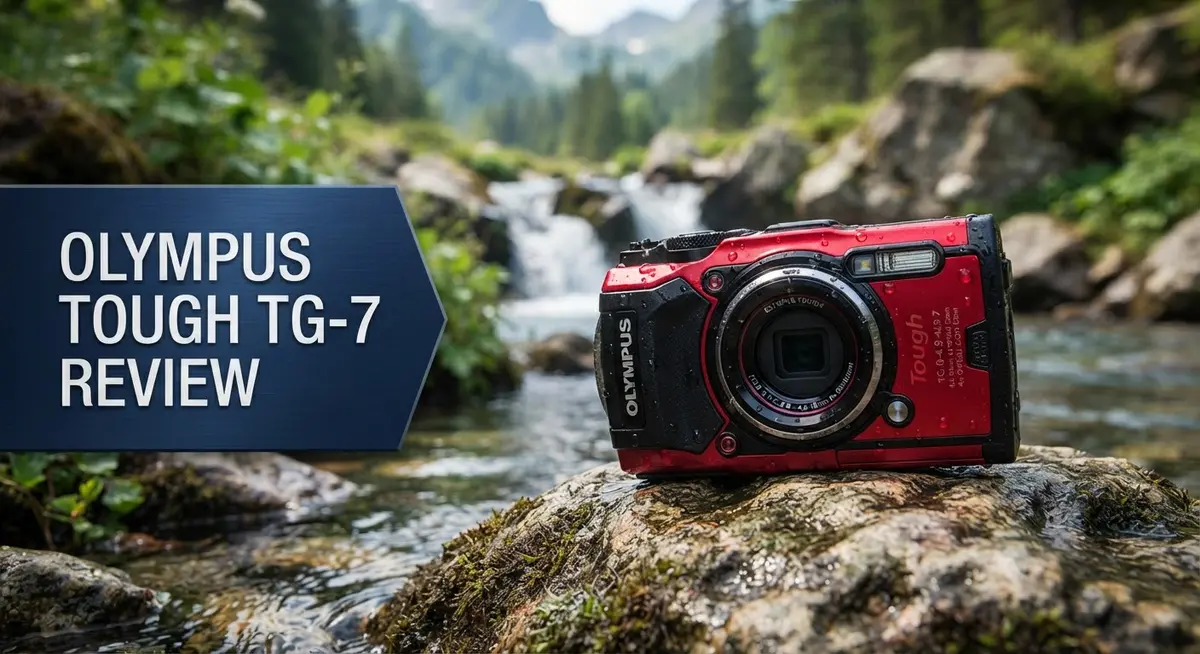
Olympus Tough TG-7 Review: Rugged Waterproof Camera?
Do you want a camera that survives drops, dust, and deep water? The Olympus Tough TG-7 might be your answer.
This rugged little camera builds on the popular TG-6. It adds a better grip and USB-C charging. These small changes make a big difference in daily use.
The TG-7 dives to 15 meters without a case. It shrugs off dust and resists drops. You can take it anywhere without worry.
Image quality still depends on a small sensor. This means it won’t beat a smartphone in every situation. But its speed and toughness make up for that gap.
In this review, we break down the TG-7’s real strengths and weaknesses. You will learn if this camera fits your adventures. Let’s explore what makes the TG-7 tick.
In a Nutshell
The TG-7 gives you a tough camera for rough adventures. Here is what stands out.
-
Grip feels better. Olympus improved the ergonomic design over the TG-6. Your hands stay steady on tricky terrain.
-
USB-C charging is here. You no longer need a proprietary cable. This makes charging simple and universal.
-
Batteries are easy to replace. You can swap them without hunting for rare parts. This keeps your shooting sessions smooth.
-
Startup speed is quick. The camera responds fast when you need it most. You will not miss sudden moments.
-
IBIS stays limited. You only get 2.5 stops of stabilization. Shaky shots can still happen in low light.
-
Focusing can struggle. Some users report slow or missed autofocus. This may frustrate you during action shots.
-
Timelapse modes improved. The interval shooting options are more flexible now. Creative shooters will enjoy this addition.
Overall, the TG-7 offers small but useful upgrades. It suits outdoor lovers who want a durable, no-fuss camera companion.
Ruggedness and Durability
The Olympus Tough TG-7 handles punishment that would destroy most cameras. This camera meets military grade durability standards. Waterproof protection extends to 15 meters (50 feet), so you can shoot underwater without a housing. The dustproof seal keeps sand and dirt away from internal components. Drop resistance means accidental tumbles won’t end your adventure.
The rugged construction shines during real world use. Hikers, divers, and outdoor workers depend on this camera because it simply works in harsh conditions. The body feels solid in your hands. Metal and rubber materials protect the lens and electronics from impact damage.
Field sensors come built in, which adds practical value for professionals. These sensors help with environmental measurement and data logging. You get more than just a camera here. The design anticipates what adventure users actually need.
Durability doesn’t mean sacrificing usability. The improved ergonomic grip makes one handed operation easier than the TG-6. Your fingers have better purchase on the camera body. This matters when you’re wearing gloves or working in wet conditions.
The USB-C port upgrade improves long term durability. Proprietary charging ports wear out faster and create compatibility issues. USB-C is a standard connection found everywhere. You can charge the camera with common cables and power banks during trips.
Battery replacement is straightforward without tools. You access the compartment quickly and swap in fresh batteries. This simple design choice extends field usability. You’re not stuck with a dead camera waiting for a charge.
Water resistance testing shows consistent performance across temperature ranges. Cold water, salt water, and freshwater all pose different challenges. The TG-7 handles these variations without issues. Olympus engineers designed this camera to survive environments where other equipment fails.
The real strength is reliability, not just specifications on paper. Thousands of users report consistent performance across years of ownership. The camera keeps working when conditions get tough. For adventure photographers who need equipment they can trust, durability becomes the most important feature.

- Waterproof 15 meters (50 feet), Dustproof, Shockproof 2.1 meters (7 feet), Crushproof 100 kilogram-force...
- High resolution F2.0 lens, maximum 4x zoom, true pic VIII, back illuminated CMOS image sensor
- Variable macro system comprised of 4 macro modes, magnified capturing up to 1 centimeter from the end of the lens

Last update on 2026-07-17 / Affiliate links / Images from Amazon Product Advertising API
Image Quality and Sensor Performance
The TG-7 uses a small 1/2.3 inch sensor with 12 megapixels. This sensor size is common in compact cameras. You get decent detail in bright sunlight. Indoor shots and low light scenes show more noise than larger sensors.
The camera’s image processor handles colors well in daylight conditions. Greens appear vibrant. Blues stay accurate. Reds maintain good saturation without looking fake. Dynamic range performs adequately for a compact rugged camera. You can recover some shadow detail in post processing.
Where the TG-7 struggles is in challenging lighting. Dim restaurants or overcast beaches reveal the sensor’s limitations. Noise becomes visible at ISO 800 and higher. The 2.5 stops of in body stabilization helps, but it cannot fully compensate for the small sensor’s light gathering ability. This means you still need good lighting for sharp handheld shots.
Macro photography is a strong point. The camera focuses as close as 3 centimeters. Details in small subjects come through clearly. Colors stay consistent even in close ups. This makes the TG-7 great for nature documentation and field research.
The autofocus system can be slow in certain situations. Low contrast scenes or fast moving subjects sometimes confuse the camera. You may need to tap the screen to help focus lock on. Manual focus mode exists but feels clunky to use.
Video recording maxes out at 4K resolution. Frame rates reach 30fps. Stabilization helps smooth out movement. Audio quality is basic, so external microphones are recommended for serious work.
The real takeaway is this: the TG-7 prioritizes toughness over image quality. It delivers acceptable photos for adventure documentation and field work. If you need professional grade images, pair it with a housing for a larger camera. If you need a camera that survives harsh conditions while capturing usable shots, the TG-7 performs well. The sensor does its job without complaints, especially in good light.
Design, Ergonomics, and Handling
The TG-7 feels noticeably better in your hands compared to its predecessor. Olympus redesigned the grip to sit more naturally during extended shooting sessions. Your fingers find purchase without slipping, even when wet or wearing gloves.
The camera’s compact frame measures just 111 x 66 x 32 millimeters. It fits easily into jacket pockets or small camera bags. The weight stays light at around 250 grams, so carrying it all day causes minimal fatigue.
Button placement deserves attention here. The power switch sits on top, within thumb reach. The shutter button has a satisfying click. Mode dials and menu controls are logically arranged. You won’t fumble around searching for functions during critical moments outdoors.
The LCD screen is a 3-inch fixed display. It rotates slightly but doesn’t flip fully. Viewing angles are decent in bright sunlight, though you may need to shield it with your hand on exceptionally bright days. The screen responds quickly to touches, making menu navigation smooth.
Physical durability is built into every surface. The body uses magnesium alloy and reinforced polymer. Seams are sealed to prevent water intrusion. The lens barrel feels solid without wobbling. Drop tests from waist height show no damage to the camera’s exterior or functionality.
The USB-C port sits flush against the body. A rubber cover protects it from sand and debris. Opening and closing the cover requires gentle pressure but stays secure during use. This is a major upgrade from the proprietary charging cable on older models.
Battery access is straightforward. You slide the battery door open without tools. The battery chamber is spacious enough to insert fresh batteries with ease. Contacts are protected from corrosion by a small cover.
The tripod socket sits on the bottom. It accepts standard quarter-inch mounts. The placement is centered, so balanced mounting is simple.
Overall, the TG-7 handles like a purpose-built tool rather than a compromise. Every design choice supports outdoor performance. Ergonomics improve without adding bulk. Durability never interferes with usability.
Top 3 Alternatives
Nikon Coolpix W300

- Waterproof, freeze proof, shockproof and dustproof adventure camera with extra capabilities
- Stunning high resolution photos, 4K Ultra HD videos, Time-lapse videos, Super lapse videos and music montages
- 5x optical zoom NIKKOR lens with telephoto power and Hybrid VR image stabilization
Last update on 2026-09-11 / Affiliate links / Images from Amazon Product Advertising API
The Nikon Coolpix W300 stands out as a rugged camera built for extreme adventures. This model survives drops from up to 2.7 meters and works underwater to 30 meters deep. You get a 16-megapixel sensor that captures sharp images in tough conditions.
The camera includes built-in GPS and an electronic compass. These features help you track your location during outdoor expeditions. The 5x optical zoom lets you frame shots without moving closer to your subject. Battery life extends to around 1,000 shots per charge, which beats many competitors.
Canon PowerShot D30

- World’s deepest* waterproof camera down to 82 ft. below sea level. * As of January 20, 2014. For compact-type...
- Shockproof to 6.5 feet, and temperature-resistant from 14 degrees to 104 degrees Fahrenheit. Based on Canon Standard.
- Capture stunning 1080p Full HD video with a dedicated movie button.
Last update on 2026-09-11 / Affiliate links / Images from Amazon Product Advertising API
The Canon PowerShot D30 brings durability and simplicity together. This waterproof camera handles depths up to 25 meters and withstands drops from 2 meters high. You get a 12.1-megapixel sensor that delivers reliable image quality.
The camera features a 5x optical zoom and a bright LCD screen. Image stabilization helps reduce blur when shooting in low light or with movement. The compact design fits easily in your pocket or backpack. Canon’s interface feels intuitive, making it perfect for users who want straightforward operation without complexity.
Ricoh WG-70

- THE ALL-WEATHER ADVENTURE CAMERA: A rugged chassis you can rely on in the harshest conditions.
- HIGH RESOLUTION WITH ALL THE MUST-HAVE FEATURES: With a high-performance image processing engine and a back-illuminated...
- WATERPROOF 14M: With features that include uncompromising waterproofing - good for 2 hours of continuous use at a depth...
Last update on 2026-09-11 / Affiliate links / Images from Amazon Product Advertising API
The Ricoh WG-70 offers exceptional versatility for adventure photography. This model survives underwater exploration to 14 meters and handles accidental drops up to 1.6 meters. The 16-megapixel sensor captures fine detail in various lighting conditions.
This camera includes macro focusing capabilities that get you within 1 centimeter of subjects. The wide-angle lens provides a 28mm equivalent focal length. You’ll appreciate the macro LED light for close-up work in dark environments. The WG-70 excels when you need flexibility for both landscape and detail photography.
Autofocus, Responsiveness, and Shooting Modes
The TG-7’s autofocus system uses contrast detection to lock onto subjects. This approach works well in bright outdoor conditions where the camera excels. In dimmer environments, the camera takes longer to find focus.
Responsiveness is where the TG-7 shines. The camera powers on quickly and moves between settings without lag. Menu navigation feels smooth. Button presses register immediately. This matters when you’re in the field and need to capture moments fast.
The shooting modes expand what you can do with this camera. Interval shooting and timelapse have improved significantly from the previous generation. You can now set more precise intervals and create longer sequences without frustration. The camera handles these automated shots reliably.
Continuous shooting reaches 10 frames per second in high speed mode. This lets you capture action sequences without missing the peak moment. The buffer clears quickly, so you’re ready for the next burst.
The camera includes manual focus options for situations where autofocus struggles. You rotate a focus ring to adjust manually. This gives you control when you need it most.
The real strength here is consistency. The TG-7 performs predictably across different scenarios. You know what to expect when you frame a shot. This reliability matters more than raw speed in a rugged camera designed for adventures.
One limitation worth noting: focusing can be slow when you’re very close to subjects. Macro work sometimes requires patience. The camera eventually locks on, but it’s not instantaneous.
The autofocus system learns from your shooting patterns too. WiFi connectivity lets you control focus remotely through your smartphone. This opens creative possibilities for angles you can’t reach easily.
Overall, the autofocus and responsiveness balance practical performance with the camera’s rugged purpose. You get a camera that responds when you need it to, without unnecessary complexity. The shooting modes give you flexibility to capture different scenarios. For outdoor enthusiasts and adventure photographers, this combination delivers what matters most.
Connectivity and Battery Life
The TG-7 connects to your smartphone and other devices through WiFi and Bluetooth. This wireless capability lets you transfer photos instantly without hunting for cables. You can control the camera remotely using your phone as a viewfinder. The connection process is straightforward and works reliably in most outdoor conditions.
USB-C charging is a major upgrade here. Unlike the TG-6, which used a proprietary connector, the TG-7 accepts any standard USB-C cable. This means you can charge it with the same cable as your laptop or tablet. No more hunting for a specific charger when you’re traveling. The USB-C port sits flush against the body, maintaining the camera’s waterproof seal.
Battery performance is solid for a compact camera. The TG-7 uses standard batteries that are easy to find and replace. You won’t struggle to locate spares at local shops or online. Battery life depends on how much you use WiFi and Bluetooth. Heavy wireless use drains power faster than shooting alone. In typical conditions, expect a full day of shooting on a single charge.
The real advantage is flexibility. You can swap batteries quickly without special tools. This matters when you’re hiking or diving where you can’t return to base camp easily. Carrying one or two extra batteries gives you peace of mind for extended trips.
Connectivity speed is respectable. File transfers happen without long delays. WiFi range extends about 30 feet in open areas. Bluetooth stays connected reliably when paired with your phone. The camera remembers your devices, so reconnecting is automatic on future outings.
One practical note: turn off WiFi and Bluetooth when you don’t need them. This simple habit extends battery life noticeably. The camera’s menu makes this adjustment easy. For serious outdoor adventures, this power management strategy keeps you shooting longer. The combination of USB-C convenience and replaceable batteries makes the TG-7 genuinely practical for field work.
Pros and Cons
Pros
- Rugged construction handles dust, water, and drops without flinching
- Improved ergonomic grip makes it more comfortable than the TG-6
- USB-C charging replaces the old proprietary port
- Quick startup and responsive performance across different shooting scenarios
- Enhanced timelapse and interval shooting modes give you creative flexibility
Cons
- Image stabilization at 2.5 stops is minimal for handheld shooting
- Small sensor produces lower image quality compared to smartphones in bright conditions
- Autofocus struggles when you focus very close to subjects
- Incremental upgrade from TG-6 may not justify switching for current owners
Who Should Buy It
The Olympus Tough TG-7 fits best with people who need a camera that survives harsh environments. If you spend time hiking, camping, or diving, this camera won’t let you down. The waterproof design goes to 15 meters, so shallow snorkeling and pool photography work well.
Adventure photographers benefit most from the rugged build. You can drop it, submerge it, and expose it to dust without worry. The improved ergonomic grip makes holding it comfortable during long outdoor sessions. This camera prioritizes durability over image quality, which appeals to people who value reliability.
Content creators doing timelapse or interval shooting will appreciate the enhanced modes. The quick startup and responsive performance mean you won’t miss moments. Continuous shooting at 10 frames per second handles action sequences. The manual focus option helps when autofocus struggles with close subjects.
Travel photographers find value here too. The compact size packs easily into bags. WiFi and Bluetooth connectivity let you transfer photos to your phone immediately. USB-C charging works with standard cables you already own. Battery costs are affordable and easy to replace in the field.
The TG-7 isn’t for everyone though. If you demand professional image quality, consider mirrorless cameras with underwater housings instead. The small sensor and 2.5 stops of stabilization limit performance in low light. Smartphone cameras actually outperform it in bright daylight conditions. Close focus struggles mean macro photography requires patience or workarounds.
Casual photographers upgrading from the TG-6 should pause. The improvements feel incremental rather than transformative. You gain better ergonomics and USB-C charging, but core image quality stays similar. Skip this upgrade unless you specifically need the enhanced timelapse features.
Choose this camera if durability matters more than image quality. Pick it when you’ll use it in water, sand, or challenging terrain regularly. Select it if you value straightforward operation and reliable performance. Pass if you want cutting-edge image quality or advanced manual controls. The TG-7 serves a specific purpose exceptionally well: being a tough camera you can trust anywhere.
Final Verdict
The Olympus Tough TG-7 stands as a solid tool for anyone who needs a camera built for tough conditions. It shines in situations where other cameras would fail.
This camera doesn’t try to compete with high end mirrorless systems. Instead it focuses on one job: surviving harsh environments while still capturing decent shots.
Adventure seekers, divers, and outdoor enthusiasts will find the most value here. The TG-7 handles water, dust, and drops without complaint. That reliability matters more than raw image quality for many users.
If you already own a TG-6, think twice before upgrading. The changes are real but small. Your current camera likely still gets the job done.
For those comparing options, the Sony RX100VA offers better image quality but lacks the same rugged protection. Action cameras like GoPro work well for video but skip photo versatility. Smartphones handle everyday shots fine but struggle underwater or in extreme conditions.
Some photographers pair a Canon EOS R10 with waterproof housing for professional results. That setup costs more effort and money though. The TG-7 skips all that hassle.
The bottom line: buy the TG-7 if durability drives your decision. Skip it if image quality tops your list.
This camera fits a specific need well. It won’t replace your main camera for portraits or studio work. But for hiking, snorkeling, or rough travel, it earns its spot in your bag.
Think about your typical shooting environment before deciding. Ask yourself what conditions you’ll actually face. That answer tells you if this camera fits your life.
The TG-7 delivers exactly what it promises: a tough, reliable companion for challenging adventures. Nothing fancy, just dependable performance when you need it most.
Frequently Asked Questions
Does the TG-7 work well underwater?
Yes, the TG-7 handles underwater use very well. It stays waterproof down to 15 meters (50 feet), so you can take it snorkeling, diving, or swimming without worry. The camera also resists dust and drops, making it ideal for beach trips where sand gets everywhere. Many adventure photographers and divers rely on this camera because it delivers consistent performance in harsh water conditions.
How is the autofocus performance?
The autofocus works fine for most shots, but it struggles when you try to focus very close to subjects. If you’re photographing tiny details or macro work, you may experience delays or missed focus. For normal outdoor shooting and landscape photos, the autofocus responds quickly and accurately. This limitation matters mainly if close-up photography is your primary goal.
Should I upgrade from the TG-6?
Probably not, unless you really want the USB-C charging port or the improved grip. The TG-7 offers incremental improvements rather than major changes. The new ergonomic design feels better in your hand, and the enhanced timelapse modes add creative flexibility. However, if your TG-6 still works well, the upgrade isn’t essential. Current owners should only switch if those specific features matter to your workflow.
How does image quality compare to my smartphone?
In bright outdoor conditions, your smartphone often produces sharper, more detailed images. The TG-7 has a small sensor that limits image quality in good lighting. However, the TG-7 wins in durability and specialized features like interval shooting. Think of it as a tool for survival, not a quality camera. Choose the TG-7 when you need a camera that survives harsh environments, not when you want stunning photos.

Kashvi is a passionate bird enthusiast and nature lover who has been fascinated by the world of birds for years. With a keen eye for detail and a love for learning, Kashvi is dedicated to sharing her knowledge and insights with fellow bird enthusiasts on Avian Enthusiasts. Through her engaging and informative articles, Kashvi aims to inspire others to join her in exploring the fascinating world of birds and to promote a deeper appreciation for these incredible creatures.