
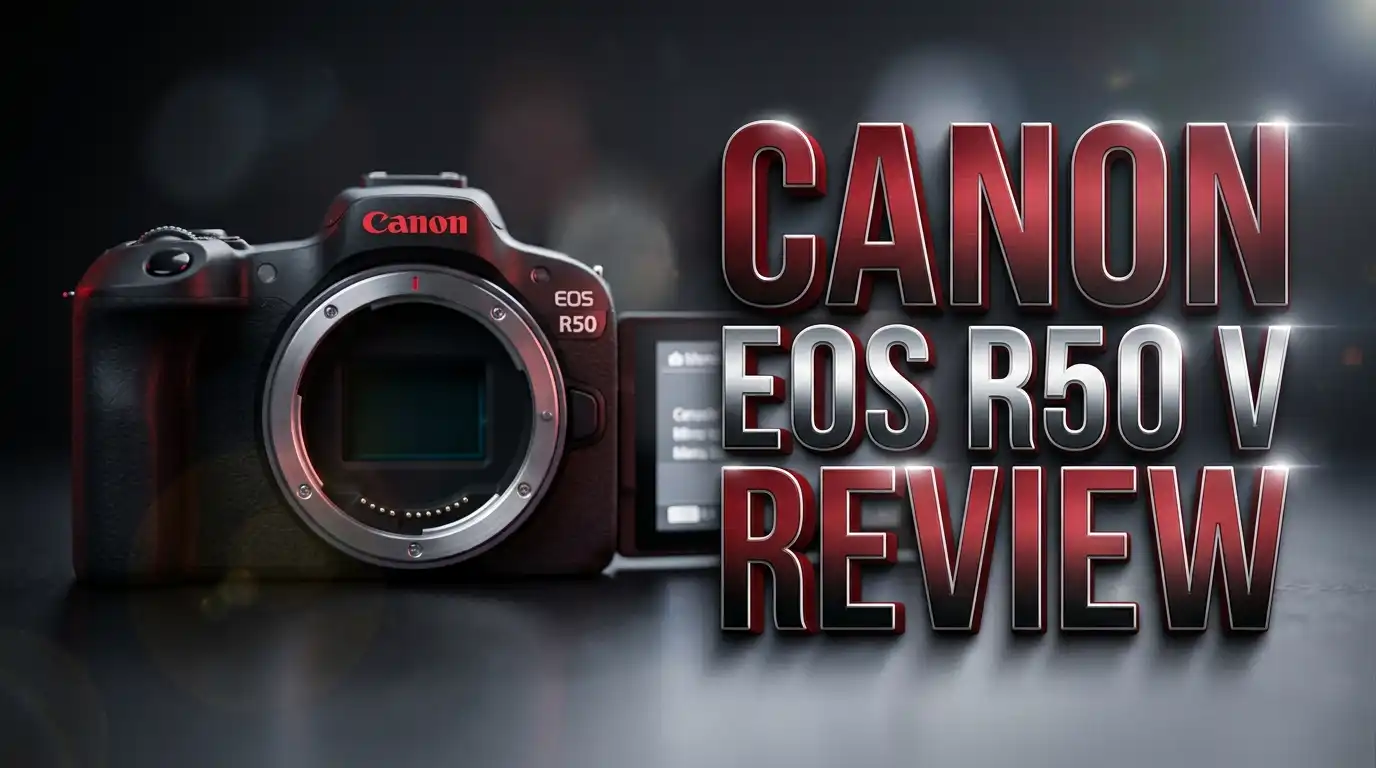
Canon EOS R50 V Review 2026: Budget Vlogging Camera?
The Canon EOS R50 V hit shelves in 2025 and quickly became a favorite among beginner creators, vloggers, and content makers on a budget. But does it still hold up in 2026? If you are looking for a lightweight, affordable mirrorless camera that puts video front and center, this camera deserves your full attention.
It packs a 24.2MP APS-C sensor, 6K oversampled 4K video, and Canon’s trusted Dual Pixel CMOS AF II autofocus system into a body that weighs just 370 grams. That is lighter than most smartphones with a case.
Whether you are a first time vlogger, a small business owner making product demos, or a traveler who wants cinematic clips without hauling heavy gear, the Canon EOS R50 V offers serious value at $649 body only. In this review, we break down every important detail so you can decide if this camera fits your needs in 2026.
Key Takeaways
- The Canon EOS R50 V is a video first camera built specifically for vloggers and content creators. It removes the viewfinder and flash from the standard R50 and replaces them with a tally light, front record button, headphone jack, and a zoom toggle switch.
- 4K video quality is excellent for the price. The standard 4K 30p mode uses 6K oversampling for sharp, detailed footage. A 4K 60p mode is available but comes with a noticeable 1.56x crop.
- Autofocus tracking is reliable and smart. It recognizes people, animals, birds, and vehicles. You can tap to track any subject on the touchscreen and it holds focus well.
- Rolling shutter is a weakness. The 4K 24p mode has a slow 31.9ms readout. Fast pans can produce visible skewing. The 4K 60p crop mode performs much better at 15.7ms.
- Battery life is decent but not class leading. Expect around 70 minutes of 4K 30p recording on a single charge. The LP-E17 battery is small compared to what Sony offers.
- At $649 body only, it undercuts most rivals like the Sony ZV-E10 II ($998) and the Fujifilm X-M5 ($799), making it a strong budget pick for 2026.
Canon EOS R50 V Overview and First Impressions

- Enjoy interchangeable lens video shooting with the first EOS V series camera body.
- Built for creators with a redesigned user interface including a Vertical Video tripod mount and Front Record button.
- Slow and Fast mode – this allows creative control of the video frame rate and playback speed.
Last update on 2026-08-29 / Affiliate links / Images from Amazon Product Advertising API
The Canon EOS R50 V launched on March 26, 2025. It carries the R50 name but has a very different design from the original Canon EOS R50. Canon stripped away the electronic viewfinder and the built in flash. In their place, the company added video focused controls and a boxier body shape.
The first time you hold it, the compact size stands out. It measures just 119 x 74 x 45 mm and weighs only 370 grams with the battery and card installed. The flat front grip makes it easy to hold facing yourself for selfie style vlogging. It does sacrifice some comfort for traditional handheld shooting though.
Canon priced the R50 V at $649 for the body only. The kit with the new RF-S 14-30mm f/4-6.3 IS STM PZ power zoom lens costs $849. That power zoom lens is a perfect match for vlogging because it offers smooth motorized zooming and a wide enough focal range for arm’s length filming.
Design and Build Quality
The R50 V has a clean, minimal design. Canon used a combination of magnesium alloy and aluminum alloy for the body. It feels sturdy for its size and price. The boxy shape works well on gimbals and tripods.
On top, you will find a large record button styled like a shutter release. Next to it sits a zoom toggle switch that controls power zoom lenses or digital zoom in 1080p. There is also a single command dial and a programmable button up top.
The mode dial is heavily video focused. It includes standard video, three custom video slots (C1, C2, C3), a slow and fast mode, a scene mode, and a fully automatic video mode. Stills shooting gets just one position on the dial. This tells you exactly who Canon made this camera for.
A handy lock button on the back prevents accidental setting changes while filming. This small detail matters a lot during run and gun vlogging sessions.
Display and User Interface
The Canon EOS R50 V uses a 3 inch fully articulated touchscreen with 1.04 million dots. It flips out and rotates to face forward, which is essential for vloggers who need to see themselves while recording.
The on screen interface has been redesigned for video use. You can access all your key settings through a scrollable Q menu without entering the full menu system. Tap the Q button on screen or press the hardware Q button, and a list of shooting parameters appears. You can change resolution, frame rate, autofocus area, color mode, stabilization, and more.
The screen does struggle in bright sunlight. Judging exposure outdoors can be difficult. This is a common issue at this price point, and Canon has not added any extra brightness modes to compensate.
One useful touch is that the interface rotates when you shoot in portrait orientation. However, the deeper menu pages do not rotate, which can feel awkward if the camera is mounted vertically on a tripod.
Top 3 Alternatives for Canon EOS R50 V
If the Canon EOS R50 V does not check every box for you, here are three strong alternatives to consider.
1. Sony ZV-E10 II offers a 26MP sensor, 4K 60p with only a 1.1x crop, much faster rolling shutter at 16.7ms, and massive battery life. It costs more at $998 but delivers superior video specs across the board.

- Exmor R CMOS sensor: The ZV-E10 II features Sony's most advanced sensor technology in an APS-C back-illuminated Exmor R...
- Interchangeable lenses to capture your vision : From the G Master series, which blends breathtaking resolution with...
- Create your look in camera: The Creative Look function makes it simple to create expressive moods for stills and movies...

Last update on 2026-08-29 / Affiliate links / Images from Amazon Product Advertising API
2. Nikon Z50 II brings a 20.9MP sensor with the EXPEED 7 processor. It has better ergonomics with two command dials, a mechanical shutter, and solid build quality. The body costs around $860.

- Go Beyond Your Phone: Capture lifelike colors and incredible details from dawn to dusk thanks to a superior...
- Find Your Aesthetic: At the press of the Picture Control button, choose from 31 built-in presets designed to make your...
- Focus with Confidence: People, dogs, cats, birds and vehicles—the Z50II can automatically detect and accurately track...
Last update on 2026-08-29 / Affiliate links / Images from Amazon Product Advertising API
3. Fujifilm X-S20 features 26.1MP, 6.2K open gate recording, Fujifilm’s beloved color science, and 5 axis in body image stabilization. It sits at a higher price but offers a more complete hybrid camera experience.

- X-S20 offers the perfect blend of power and portability to turn thoughts and ideas into reality. Weighing just 491g...
- X-S20 combines powerful sensor and processor technologies to deliver a blistering performance for stills and...
- Thoughtful ergonomics and cutting-edge technology make camera shake and blurry imagery a distant memory with X-S20. The...
Last update on 2026-08-29 / Affiliate links / Images from Amazon Product Advertising API
Video Performance and Quality

- Enjoy interchangeable lens video shooting with the first EOS V series camera body.
- Highly versatile RF-S14-30mm F4-6.3 IS STM PZ lens (approx. 35mm equivelant of 22-48mm) is included to deliver reliable...
- Built for creators with a redesigned user interface including a Vertical Video tripod mount and Front Record button.
Last update on 2026-10-13 / Affiliate links / Images from Amazon Product Advertising API
Video is where the Canon EOS R50 V truly shines. The standard 4K 30p mode pulls from a 6K readout of the full sensor width. This oversampling produces crisp, detailed footage that looks great on YouTube, Instagram, and TikTok.
The camera supports 10 bit 4:2:2 recording in both H.264 and H.265 codecs. You get Canon’s C-Log 3 color profile for flat footage that is ready for color grading. HDR PQ and HLG modes are also available for those who want HDR output.
The 4K 60p mode is useful for slow motion. However, it applies a 1.56x crop that makes your image noticeably tighter. If you pair this with digital stabilization, the total crop can reach 2.23x in enhanced mode. That means your wide angle lens suddenly feels much narrower.
Canon also added a Slow and Fast mode for in camera slow motion and timelapse recording. A Cinema View mode adds 2.35:1 letterbox bars directly to your footage for a cinematic look.
Autofocus System
The Canon EOS R50 V uses Dual Pixel CMOS AF II with 651 autofocus zones. It covers a large portion of the sensor and delivers fast, accurate focusing. This is the same autofocus technology found in Canon’s higher end cameras.
Subject recognition works for people, animals (including birds), and vehicles. An auto mode tracks any recognized subject type. You can also tap the touchscreen to lock onto a specific object or area. The camera holds focus well even during moderate camera movement.
Focus speed and tenacity are adjustable. You can set faster transitions for quick cuts or slower transitions for smooth focus pulls. The system handles zoom changes well and does not lose subjects after zooming in or out.
One limitation is the close up demo mode. It only works in the Scene mode, not in standard video modes. This means you cannot use your preferred exposure settings while demonstrating products close to the camera.
Image Quality for Stills
The R50 V carries the same 24.2MP APS-C CMOS sensor and DIGIC X processor as the regular EOS R50. Still photos are sharp, well exposed, and show good color accuracy. Dynamic range is solid for an APS-C camera at this price.
The camera supports 12 fps burst shooting with the electronic first curtain shutter and 15 fps with the full electronic shutter. RAW files give you plenty of room for editing in Lightroom or Capture One.
That said, stills are not the main focus here. The lack of a viewfinder makes it harder to compose shots in bright conditions. The single front mounted command dial on the top plate forces you to manage both exposure parameters with your thumb. If you split your time equally between photos and video, the standard Canon EOS R50 or the Fujifilm X-M5 might be a better fit.
Rolling Shutter and Stabilization
Rolling shutter is the biggest weakness of the Canon EOS R50 V. In 4K 24p, the sensor readout takes 31.9 milliseconds. This causes visible skewing during fast pans or with quickly moving subjects. The jello effect can be distracting in certain shooting styles.
The good news is that the 4K 60p crop mode has a much faster readout at 15.7ms. The 1080p modes also perform well at 12.3ms. If you shoot mostly talking head or static content, rolling shutter will rarely be an issue.
For stabilization, the R50 V relies on optical image stabilization from compatible lenses and electronic image stabilization in two modes. The normal mode adds a 1.11x crop at 4K 24p. The enhanced mode increases that to 1.41x. Both work at 4K 60p but the total crop becomes significant.
The electronic stabilization works acceptably for static or slow moving shots. Walk and talk footage can look wobbly rather than smooth. A gimbal remains the best option for moving shots.
Audio Features
Canon gave the R50 V a three microphone array built into the body. It captures clear audio for basic vlogging situations. However, Canon did not include a wind sock in the box. Outdoor recordings will pick up wind noise without an aftermarket accessory.
The camera has both a 3.5mm microphone input and a 3.5mm headphone jack. The headphone jack is a welcome addition that the standard R50 lacks. Monitoring your audio in real time helps you catch problems before they ruin a take.
The built in microphones perform well enough for indoor talking head content. For anything outdoors or in noisy environments, an external microphone is strongly recommended. The Rode VideoMicro or a small wireless lavalier system pairs nicely with this camera.
Connectivity and Streaming
The Canon EOS R50 V includes a USB-C port rated at 10 Gbps. This is faster than what the Sony ZV-E10 II and Nikon Z30 offer. Fast transfer speeds make it easy to offload large video files to your computer without removing the SD card.
The camera supports UVC/UAC streaming over USB. You can use it as a 4K webcam for Zoom, OBS, or other streaming software. If you need power while streaming, the resolution drops to 1080p over USB.
Wi-Fi connectivity covers both 2.4 GHz and 5 GHz bands. Bluetooth is available for low power connections to your smartphone. Canon’s Camera Connect app lets you transfer photos and control the camera remotely.
A micro HDMI port is also present for external monitor output or connecting to a capture card for live streaming setups.
Battery Life and Storage
The R50 V uses Canon’s compact LP-E17 battery with a 7.5 Wh capacity. Canon rates it at approximately 390 shots using the CIPA standard. For video, expect around 70 minutes of continuous 4K 30p recording. Shooting in 1080p roughly doubles that to about 140 minutes.
This battery life is adequate but not impressive. The Sony ZV-E10 II lasts significantly longer thanks to its larger NP-FZ100 battery rated at 610 CIPA shots. If you plan long recording sessions, carry a spare LP-E17 battery or keep a USB-C power bank nearby.
The single SD card slot sits under a door on the bottom of the camera. It supports UHS-II cards for fast write speeds. This placement means you will need to remove the camera from a tripod to swap cards. The fast USB-C port offers a convenient alternative for file transfers.
Who Should Buy the Canon EOS R50 V
The Canon EOS R50 V is ideal for beginner vloggers and content creators who want interchangeable lens quality without spending over $1000. It suits YouTubers, TikTok creators, small business owners making product videos, and travelers who want light gear.
It is also a good pick for anyone already invested in the Canon RF lens ecosystem. You get access to a growing library of RF-S lenses, plus adapters for older EF and EF-S glass.
This camera is not the best choice if you need strong still photography performance. It also falls short for action or sports videography because of its slow rolling shutter in 4K 24p. Professionals who need long recording times or dual card slots should look elsewhere.
If your budget stretches higher and you want better rolling shutter and longer battery life, the Sony ZV-E10 II is the stronger option. If you want a true hybrid for both stills and video, consider the Fujifilm X-S20 or the standard Canon EOS R50.
Canon EOS R50 V vs Canon EOS R50
These two cameras share a name and a sensor, but they serve different users. The original EOS R50 has an electronic viewfinder, a built in flash, and a more pronounced grip. It is better for photography focused users who also want good video.
The EOS R50 V drops the viewfinder and flash. It adds a headphone jack, front tally light, front record button, zoom toggle, vertical tripod mount, and a video heavy mode dial with three custom video presets. It also gains 4K 60p recording, Canon Log 3, and the upgraded menu system from higher end Canon cameras.
The R50 costs about $680 body only. The R50 V costs $649 body only. You actually pay less for the V model while getting more video features. If video is your priority, the R50 V is the clear winner. If you want a balanced camera for both stills and video, the original R50 makes more sense.
Lens Options for the Canon EOS R50 V
The R50 V uses the Canon RF mount and works best with compact RF-S lenses. The dedicated kit lens is the RF-S 14-30mm f/4-6.3 IS STM PZ. This power zoom lens is wide enough for arm’s length vlogging and offers smooth motorized zooming.
Other popular choices include the RF-S 18-45mm f/4.5-6.3 IS STM for general use and the RF-S 55-210mm f/5-7.1 IS STM for telephoto reach. The RF-S 18-150mm f/3.5-6.3 IS STM is a great all in one travel lens.
Canon’s third party lens policy is worth noting. The company restricts third party lens makers from producing RF mount lenses. This limits your affordable lens options compared to Sony or Fujifilm systems. You can use an EF to RF adapter to access the large catalog of older Canon EF and EF-S lenses, which opens up many budget friendly options on the used market.
Pros and Cons Summary
The Canon EOS R50 V gets a lot right for its price. Great video quality, reliable autofocus, and thoughtful vlogging controls make it a standout budget option. The vertical tripod mount, front tally light, and headphone jack show that Canon understood what creators need.
On the downside, the rolling shutter in 4K 24p is poor. The 4K 60p crop is large. The electronic stabilization does not match what software based solutions or IBIS cameras can deliver. Battery life is just okay. And Canon’s lens restrictions limit third party options.
Overall, the Canon EOS R50 V earns a strong recommendation for budget conscious video creators in 2026. It offers the best value in its class and delivers results that punch well above its price tag.
Frequently Asked Questions
Is the Canon EOS R50 V good for beginners in 2026?
Yes. The R50 V is one of the best beginner cameras available in 2026. Its automatic video modes handle exposure, focus, and color for you. The touchscreen interface is intuitive. The $649 price makes it accessible for first time creators who want interchangeable lens quality.
Can the Canon EOS R50 V shoot 4K 60fps?
Yes. The R50 V records 4K video at 60 frames per second. However, this mode applies a 1.56x crop to the image. If you add electronic stabilization, the crop becomes even larger. The 4K 30p mode uses the full sensor width and produces sharper results.
Does the Canon EOS R50 V have image stabilization?
The R50 V does not have in body image stabilization (IBIS). It relies on optical stabilization from compatible lenses and two levels of electronic stabilization. For the steadiest footage, use a gimbal or tripod.
How long can the Canon EOS R50 V record video?
Canon states the R50 V can record approximately 70 minutes of continuous 4K 30p video on a full battery charge. It can record up to 140 minutes in 1080p. The overheating limit is around 55 minutes of 4K at standard temperature settings.
Is the Canon EOS R50 V better than the Sony ZV-E10 II?
The Sony ZV-E10 II offers better rolling shutter, less crop at 4K 60p, longer battery life, and a wider third party lens selection. The Canon EOS R50 V costs significantly less at $649 versus $998. If budget is your main concern, the R50 V delivers excellent value. If you want the best specs, the Sony is the stronger camera.
What memory card does the Canon EOS R50 V use?
The R50 V has a single SD card slot that supports UHS-II speed cards. A fast UHS-II card is recommended for recording high bitrate 4K video without dropped frames. Cards with at least 64GB capacity are ideal for extended shooting sessions.

Kashvi is a passionate bird enthusiast and nature lover who has been fascinated by the world of birds for years. With a keen eye for detail and a love for learning, Kashvi is dedicated to sharing her knowledge and insights with fellow bird enthusiasts on Avian Enthusiasts. Through her engaging and informative articles, Kashvi aims to inspire others to join her in exploring the fascinating world of birds and to promote a deeper appreciation for these incredible creatures.
