
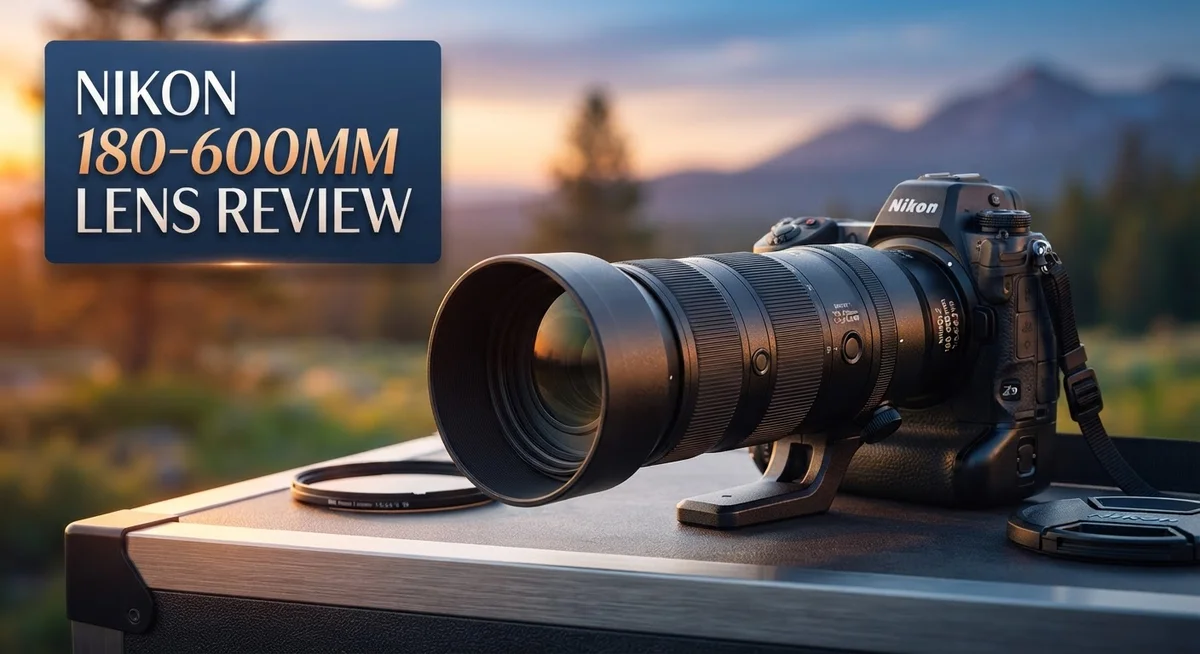
Nikon Z 180-600mm f/5.6-6.3 VR Lens Review: Worth Buying?
Do you love wildlife or sports photography? The Nikon Z 180-600mm f/5.6-6.3 VR lens might be your new best friend.
This lens covers a huge zoom range. You get 180mm all the way to 600mm in one package.
Sharpness impresses across most of this range, especially between 180-400mm. Colors pop and details stay crisp.
Nikon built this lens with an internal focusing design. It does not extend when you zoom. This makes handling smoother and more balanced.
For a super-telephoto zoom, it stays surprisingly light. Carrying it for long shoots feels less tiring than similar lenses.
Autofocus runs on the slower side. Still, image quality makes up for this small tradeoff.
Want to know if this lens fits your camera bag? Let us break down every detail below.
In a Nutshell
This lens gives you serious reach for wildlife and sports shots. Here is a quick summary before you dive deeper.
-
Zoom Range: You get 180-600mm in one package. This flexibility helps you capture distant subjects without switching lenses.
-
Build Quality: Nikon used an internal focusing and zooming design. Nothing extends outward, so the lens feels stable and balanced in your hands.
-
Weight: This lens ranks among the lightest in its class. Your arms will thank you during long shooting sessions.
-
Teleconverter Ready: Pair it with a 1.4x teleconverter for extra reach. Nikon recommends this combo for specific shooting needs.
-
Autofocus Speed: Autofocus works well but runs slower than pro-grade lenses. Fast action shots might need extra patience.
-
Best Use Case: This lens suits dedicated telephoto work. If you need a multipurpose lens, the Nikon Z 100-400mm offers more versatility.
Think about your shooting style before you commit. This lens rewards photographers who need serious zoom power for specific situations.
Optical Performance and Sharpness
The Nikon Z 180-600mm delivers exceptional optical clarity when you push it to its strengths. This lens performs best in the 180-400mm range, where sharpness reaches its peak performance. You’ll notice crisp, detailed images with minimal optical degradation across this sweet spot.
Beyond 400mm, the lens maintains solid sharpness, though some edge softness becomes visible at maximum focal length. This is normal behavior for super-telephoto zooms. The variable aperture (f/5.6 at 180mm dropping to f/6.3 at 600mm) means less light reaches your sensor at longer distances, but the internal lens elements stay optimized for clarity throughout the zoom range.
The internal focusing mechanism plays a key role here. Elements move inside the barrel rather than extending outward, which keeps optical paths consistent and reduces aberrations. You get more predictable sharpness performance compared to extending designs.
Vibration reduction technology helps you capture sharp shots even without a tripod. At 600mm, camera shake becomes a real concern, so VR gives you extra insurance. Most users report reliable stabilization that lets you hand-hold in decent light conditions.
Color rendering impresses too. The lens produces accurate, saturated colors with minimal color fringing. Contrast stays punchy throughout the zoom range. Backlit subjects show good flare resistance, though strong direct sun can produce some internal reflections (common in all telephoto lenses).
When you pair this lens with a 1.4x teleconverter, sharpness holds up surprisingly well. The optical design accounts for teleconverter compatibility, so you won’t see dramatic quality drops. This flexibility matters if you need that extra 840mm reach occasionally.
One honest note: autofocus speed doesn’t match professional-grade telephoto lenses. Tracking moving subjects requires patience and proper technique. Fast-moving wildlife or sports action demand your best focusing skills. Static subjects or slower-moving targets present no problems.
The optical performance justifies serious consideration for dedicated telephoto work. You’re getting legitimate sharpness, color accuracy, and reliability in a package that won’t exhaust your arms on long shooting days.

- Ease of use. At its widest setting, the NIKKOR Z 180-600 f/5.6-6.3 VR is great for locating your subject. With a mere...
- Handheld shooting. Built-in optical Vibration Reduction (VR) provides a stabilization effect equivalent to a shutter...
- Versatile close shooting. The lens features a minimum focus distance of 4.27 ft at the 180mm zoom position and a large...

Last update on 2026-09-13 / Affiliate links / Images from Amazon Product Advertising API
Design, Build Quality, and Weight
The Nikon Z 180-600mm features a non-extending barrel design that keeps things compact during storage and transport. This internal focusing and zooming system means the lens doesn’t grow longer as you zoom, which is a smart engineering choice for telephoto work.
The barrel itself uses a mix of materials that balance durability with weight. Nikon incorporated weather sealing into the design, so you get some protection against dust and moisture during outdoor shoots. The rubber grip zones feel comfortable during extended handheld sessions, though the sheer size demands respect.
Weight sits among the lightest options in the super-telephoto zoom category. You won’t mistake it for a compact lens, but it stays manageable compared to older telephoto designs. The weight distribution feels well-balanced, which matters when you’re holding this lens for hours during wildlife or sports events.
The focus ring operates smoothly with good resistance. You can make precise adjustments without accidentally spinning past your target. The zoom ring turns with consistent tension throughout the range, though it requires deliberate hand movements to shift between 180mm and 600mm.
Build quality reflects Nikon’s attention to detail. Seams appear clean and tight. The metal components feel solid without excessive heft. The lens hood mounts securely and protects the front element effectively.
One practical note: this lens demands a sturdy tripod or monopod for serious work. The size and weight combination means handheld shooting works best at shorter focal lengths or with image stabilization engaged. VR technology helps considerably when you shoot without support, though a stable base always improves results.
The overall construction suggests this lens expects dedicated use. It’s not a grab-and-go travel companion. Instead, it’s purpose-built for photographers who plan their shoots around telephoto requirements. The robust construction should handle years of regular use when properly maintained.
Autofocus Speed and Vibration Reduction
The autofocus system on this lens performs at a consumer-grade level. You’ll notice it focuses reliably for most shooting situations, but it won’t match the lightning-fast response of professional telephoto lenses. This matters most when you track fast-moving subjects like birds in flight or sports action.
The internal focusing mechanism helps keep autofocus performance consistent across the entire 180-600mm range. You won’t experience the focus breathing that plagues some other telephoto designs. This stability proves useful when you’re filming video or composing precise shots.
Vibration reduction makes a real difference here. The VR system helps you hand-hold the lens at longer focal lengths without a tripod. At 600mm, you can typically shoot at shutter speeds around 1/250th of a second and still get sharp images. This flexibility opens up shooting opportunities when you can’t set up a tripod.
The VR system operates silently and doesn’t drain your battery excessively. You can toggle it on or off depending on whether you’re using a tripod. When mounted on a sturdy support, turning VR off prevents any potential micro-movements that might affect image quality.
Combining the autofocus speed with vibration reduction creates a practical tool for wildlife photographers and sports shooters. The lens won’t hunt for focus in low light conditions the way some consumer-grade systems do. Instead, it locks on smoothly and holds focus through most tracking scenarios.
One honest consideration: if you regularly shoot fast-moving subjects in challenging light, you might want to explore professional-grade telephoto options. However, for dedicated telephoto work in good lighting, this lens delivers solid autofocus performance paired with effective vibration reduction.
The balance between autofocus capability and VR technology makes this lens suitable for photographers who understand its limitations and plan their shoots accordingly. You get reliable performance without paying for features you won’t use.
Top 3 Alternatives
Tamron 150-500mm Lens

- Mastering the magical world of 500mm ultra-telephoto zoom lenses
- Enjoy comfortable handheld shooting with a compact full-featured, full-frame 500mm lens
- Uncompromising high image quality throughout the entire zoom range
Last update on 2026-09-28 / Affiliate links / Images from Amazon Product Advertising API
The Tamron 150-500mm offers excellent reach for wildlife and sports photography. This lens delivers sharp images across its entire zoom range. Vibration compensation helps you capture steady shots even in challenging light. The weather-sealed construction protects your investment during outdoor adventures.
The autofocus system performs quickly and quietly. You get smooth zoom operation with minimal effort. This lens works well on various camera bodies, making it a flexible choice for photographers who switch between systems.
Sony FE 200-600mm

- Outstanding g lens resolution throughout the Zoom range
- 5x ED (extra-low dispersion) glass elements Reduces flare & ghosting
- Direct drive Supersonic Wave Motor for fast, quiet, precise focus
Last update on 2026-09-28 / Affiliate links / Images from Amazon Product Advertising API
Sony’s FE 200-600mm brings professional-grade performance to your camera bag. The lens features advanced autofocus technology that locks onto subjects fast. You’ll appreciate the compact design compared to other super-telephoto options. Weather sealing keeps moisture and dust away from your optics.
Image stabilization helps you shoot handheld at longer focal lengths. The zoom range covers everything from distant wildlife to tight sports action. Sony’s lens coating reduces flare and improves contrast in bright conditions. This option pairs perfectly with Sony’s full-frame mirrorless cameras.
Canon RF 100-500mm

- High Performance L-series versatile Super-Telephoto Zoom RF Lens.
- Optical Image Stabilization with up to 5 stops* of Shake Correction.
- Three Image Stabilization Modes (Standard, Panning, and during exposure only) Provided for Creative Versatility.
Last update on 2026-09-11 / Affiliate links / Images from Amazon Product Advertising API
Canon’s RF 100-500mm combines versatility with impressive optical quality. The lens starts at 100mm, giving you flexibility for medium-distance subjects. Optical image stabilization ensures sharp results throughout the zoom range. The RF mount connection provides fast data transfer between lens and camera.
The autofocus system tracks moving subjects with precision. Dust and moisture sealing protects internal elements during field use. You get smooth, silent focusing ideal for video work. This lens balances reach and portability, making it practical for travel photography.
Teleconverter Compatibility and Versatility
The Nikon Z 180-600mm works exceptionally well with teleconverters, opening up new creative possibilities for your telephoto work. A 1.4x teleconverter is the recommended pairing for this lens, and sharpness remains impressive when you use it together.
When you attach a 1.4x teleconverter, your effective focal range extends to 252-840mm. This gives you extra reach without sacrificing much optical quality. The internal focusing design helps maintain autofocus performance even with the teleconverter attached, though you should expect slightly slower focusing speeds.
Versatility expands significantly with teleconverter compatibility. You get flexibility to shoot at different magnifications without swapping lenses in the field. This matters for wildlife photographers who need to adjust composition quickly or for sports shooters working from fixed positions.
One practical consideration: teleconverter use does reduce light transmission by about one stop. Your effective aperture becomes f/8-9 with a 1.4x converter. In bright outdoor conditions, this rarely causes problems. In lower light situations, you’ll notice the impact on autofocus performance.
The lens design handles teleconverters better than many super-telephoto options in its class. The optical formula remains well-corrected even at extended focal lengths. You won’t see dramatic increases in chromatic aberration or distortion when using a quality teleconverter.
Beyond teleconverter compatibility, this lens offers solid versatility within its core range. The 180-600mm span covers most wildlife and sports scenarios without requiring multiple lenses. The internal focusing mechanism means you can adjust focus smoothly without the barrel extending, making it easier to use on a tripod.
However, versatility has limits here. This lens demands dedicated purpose. It’s not a do-everything zoom like the 100-400mm alternative. You’re investing in a specialized tool for specific shooting situations rather than a multipurpose lens for varied work.
The combination of teleconverter compatibility and the broad focal range makes this lens a smart choice for photographers who know what they want to shoot. You get reach, optical quality, and practical flexibility when you need it.
Ideal Use Cases and Photography Scenarios
This lens shines in specific photography scenarios where you need serious reach without breaking your workflow.
Wildlife photography is where this lens truly excels. Whether you’re photographing birds in flight, distant mammals on a safari, or reptiles that won’t let you get close, the 180-600mm range gives you the magnification you need. The excellent sharpness from 180-400mm means your shots stay crisp and detailed. The internal focusing design keeps the lens compact during operation, which matters when you’re moving through brush or water.
Sports photographers benefit from the extended range too. Track and field events, motorsports, and outdoor competitions often require you to shoot from fixed positions far from the action. The vibration reduction system becomes your ally here, letting you maintain sharp images even when you’re hand-holding at 600mm during lower light conditions like evening games.
Nature and landscape work takes on new dimensions with this lens. Telephoto compression flattens backgrounds and isolates subjects beautifully. Photographers capturing wildlife in their natural habitat, insects at distance, or dramatic cloud formations over mountains find this range invaluable.
Birding enthusiasts appreciate the specialized focus. Stationary birds at moderate distances work perfectly in the 180-400mm sweet spot. When you attach a 1.4x teleconverter, your reach extends to 840mm for those rare species that demand extreme magnification.
Astrophotography also benefits from this lens. The 600mm focal length reaches deep into the night sky for moon photography and certain celestial events. The internal focusing mechanism prevents shift during long exposures.
One important reality: this lens demands dedicated purpose. You won’t casually throw it in a bag for general photography. The size and weight require serious commitment. You need a sturdy tripod or monopod for consistent results. The slower autofocus means fast-moving subjects in dim light might challenge the system.
This lens works best when you know exactly what you’re shooting and why you need that specific reach. It’s not a do-everything lens. It’s a specialist tool that delivers exceptional results in its intended scenarios.
Pros and Cons
Pros
- Exceptional sharpness throughout the 180-400mm range delivers stunning image quality
- Internal focusing and zooming design keeps the lens length fixed, making it easier to handle and transport
- Lightweight construction for a super-telephoto zoom makes it genuinely portable compared to competitors
- Works beautifully with 1.4x teleconverters to reach 252-840mm without major quality loss
- Silent and efficient vibration reduction lets you hand-hold confidently at longer focal lengths
Cons
- Autofocus speed lags behind professional-grade telephoto lenses, which matters for fast-moving subjects
- Large and bulky size demands serious commitment and dedicated camera support like tripods or monopods
- Requires you to know your shooting purpose in advance, limiting spontaneous versatility compared to general-use zooms
- Narrower maximum aperture (f/5.6-6.3) means reduced light gathering in dim conditions or when using teleconverters
Who Should Buy It
This lens speaks to a specific photographer. You need serious reach and know exactly what subjects you’re chasing.
Professional wildlife photographers find this lens essential. You’re shooting from a distance, tracking movement, and need consistent sharpness. The 180-600mm range gives you flexibility without changing lenses constantly. The internal focusing design means no barrel extension distracts your subjects or throws off your balance.
Sports shooters benefit from the extended telephoto reach. You’re covering events where distance matters. The vibration reduction keeps your images sharp during hand-held shooting, even at 600mm. The lightweight design matters when you’re moving between positions all day.
Birding enthusiasts appreciate the specialized capabilities here. You get the magnification needed to capture detail on distant subjects. The fixed lens length makes setup and breakdown faster in the field. Silent autofocus won’t startle your subjects.
Nature photographers working with landscapes and distant details find real value. You can isolate specific elements in expansive scenes. The sharpness through the 180-400mm range delivers stunning results for prints and galleries.
Astrophotography hobbyists also benefit from this lens. The longer focal length helps you frame distant celestial objects. Stable vibration reduction aids longer exposures without a star tracker.
However, this lens isn’t for casual photographers. You need a dedicated purpose. If you shoot weddings, events, and travel all in one day, the 100-400mm alternative offers more flexibility. This lens demands you commit to its specialty.
You should also own solid support equipment. A tripod or monopod becomes essential at 600mm. Your camera bag needs real capacity. Hand-holding works thanks to VR, but stability matters for consistent sharpness.
The right buyer understands their shooting needs clearly. You’re not buying this hoping it solves multiple problems. You’re buying it because you know you need 600mm reach regularly. You’ve researched your subjects and understand the distances involved. You’re ready to invest in a lens that does one job exceptionally well.
Final Verdict
The Nikon Z 180-600mm lens earns its place as a serious tool for a specific job. It rewards photographers who plan their shots and understand long glass.
If you shoot fast action every week, this lens still delivers. But you must accept its size and weight as part of the deal.
Compare this to the Nikon Z 100-400mm, and the choice becomes clearer. The 100-400mm suits photographers who want one lens for many situations. The 180-600mm suits photographers who chase one goal with total focus.
This lens rewards patience. You learn its quirks, and it gives back sharp, detailed images that shorter lenses cannot match.
Think about your typical day behind the camera. Do you often need 400mm or more? If yes, this lens fits your kit perfectly.
Do you switch between portraits, events, and occasional wildlife shots? Then a shorter, lighter zoom might serve you better day to day.
This lens is not a jack of all trades. It is a specialist tool built for photographers who already know their subject and their style.
New photographers exploring telephoto work for the first time may find better value in shorter zooms first. Build skills, then step up to this lens when your needs demand it.
Experienced shooters chasing distant subjects will find a true partner in this lens. It handles the technical side so you can focus on composition and timing.
Final thought: buy this lens when you know exactly why you need it. Skip it if you are still exploring your photography style.
For the right photographer, this lens becomes an essential part of their kit. It opens up shots that once felt impossible to capture.
Choose wisely based on your actual shooting habits, not just specs on paper. That choice makes all the difference in how much you enjoy using this lens.
Frequently Asked Questions
Can I use this lens on a full frame Nikon Z camera?
Yes, the Nikon Z 180-600mm is built specifically for Nikon’s full frame Z mount cameras. It works seamlessly with models like the Z9, Z8, Z6 III, and other Z series bodies. The lens takes full advantage of the Z mount’s wide throat and short flange distance for optimal optical performance.
How does autofocus performance compare to other telephoto lenses?
The autofocus speed sits in the consumer-grade range rather than professional territory. It’s not the fastest option available. For fast-moving wildlife or sports action, you may notice it hunts slightly longer than premium telephoto alternatives. However, it performs reliably for stationary or slower subjects like landscape photography or birding.
Will a teleconverter work with this lens?
Absolutely. The 1.4x teleconverter pairs beautifully with this lens, extending your reach to 252-840mm without significant quality loss. A 2.0x converter also works but delivers softer results and slower autofocus. The 1.4x remains the sweet spot for maintaining sharpness and performance.
What tripod support do I need?
This lens is large and demands proper support. A sturdy tripod or monopod becomes essential equipment, not optional. Handheld shooting works thanks to the vibration reduction system, but extended sessions benefit greatly from stable support. Plan your gear setup around this reality before purchasing.
Is this better than the Nikon Z 100-400mm?
Each lens serves different purposes. The 100-400mm offers more versatility for mixed shooting scenarios. This 180-600mm provides extended reach for dedicated telephoto work. Choose based on how you actually shoot, not on specs alone.

Kashvi is a passionate bird enthusiast and nature lover who has been fascinated by the world of birds for years. With a keen eye for detail and a love for learning, Kashvi is dedicated to sharing her knowledge and insights with fellow bird enthusiasts on Avian Enthusiasts. Through her engaging and informative articles, Kashvi aims to inspire others to join her in exploring the fascinating world of birds and to promote a deeper appreciation for these incredible creatures.

