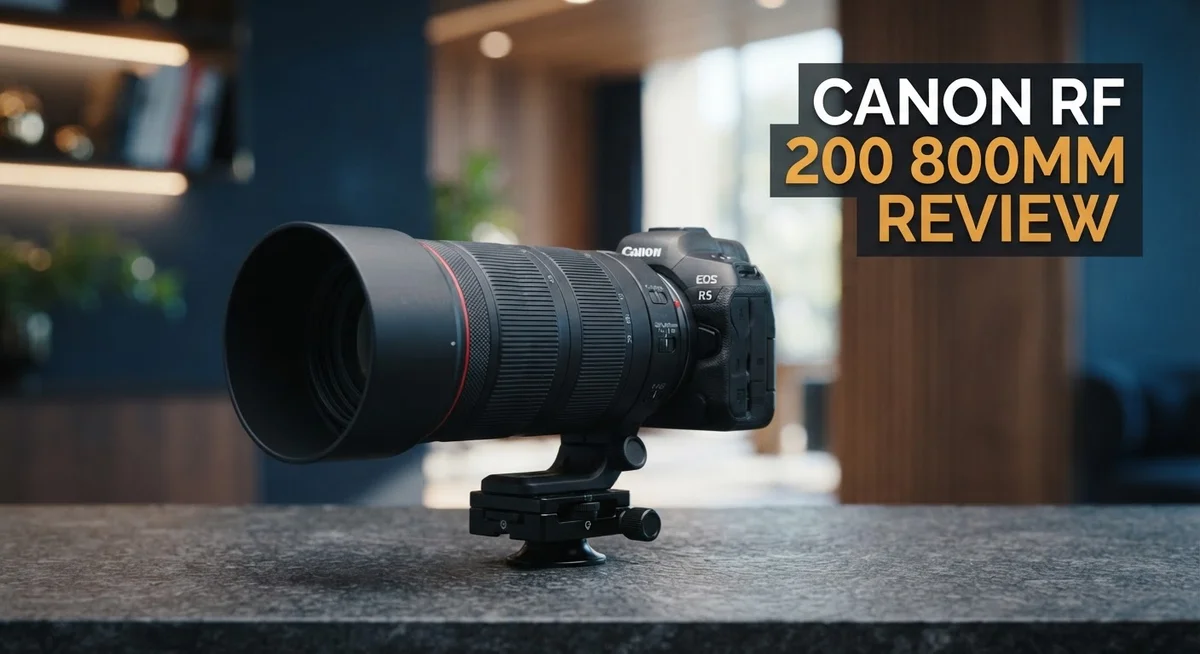
Canon RF 200-800mm F6.3-9 IS USM Lens Review: Features, Performance & Specifications
Wildlife photography just got easier. The Canon RF 200-800mm F6.3-9 IS USM gives you a massive zoom range in one lens.
You can shoot distant birds at 200mm. Then zoom to 800mm for tight close ups. This flexibility makes it a great choice for safari trips and backyard birdwatching alike.
This lens packs serious reach. With a 4x zoom range and the option to extend to 1600mm, you get creative freedom most lenses cannot match.
Is it sharp enough for serious shooters? Yes. Canon built this lens with 17 elements and 3 UD elements for crisp results across the entire zoom range.
It also feels lighter than you might expect for a super telephoto lens. Hand held shooting feels stable and comfortable.
Let’s explore what makes this lens worth your attention.
In a Nutshell
Here’s a quick look at what this lens brings to the table.
-
Massive reach with extender: Pair it with a 2x extender and you get 400-1600mm. That’s incredible range for distant subjects.
-
Smart stabilization: The built-in Image Stabilization helps you shoot steady shots even without a tripod. Your hands stay calmer.
-
Autofocus has limits: The USM autofocus works well in good light. It can struggle a bit in low light or busy scenes.
-
Narrower aperture at long end: The aperture drops to F9 at 800mm. This means less light reaches the sensor at full zoom.
-
Decent close-up ability: With a 0.54x magnification ratio, you can capture small details too. It’s not just for far away subjects.
-
Thoughtful optical design: With 17 elements across 11 groups, this lens controls sharpness and color well. It uses three UD elements for extra clarity.
This lens suits photographers who want flexibility. It handles long range shots and closer details with ease.
Optical Design and Specifications
The Canon RF 200-800mm F6.3-9 IS USM uses a sophisticated optical formula to deliver performance across its entire zoom range. The lens contains 17 elements arranged in 11 groups, which work together to minimize aberrations and maintain image quality from 200mm all the way to 800mm.
Three UD (Ultra-Low Dispersion) elements sit within this design. These special glass pieces reduce chromatic aberration, which means colors stay sharp and true even at extreme magnifications. This matters most when you’re shooting wildlife or distant subjects where color accuracy counts.
The aperture specification tells an important story about this lens. At 200mm, you get F6.3, which is reasonable for a zoom lens. However, the aperture narrows to F9 at the 800mm end. This narrower aperture at telephoto distances means less light reaches your sensor, so you’ll need faster shutter speeds or higher ISO settings in dim conditions. Bright daylight shooting won’t present problems, but overcast days require adjustment.
Maximum magnification reaches 0.54x, which is solid for a super-telephoto zoom. You can focus close enough to capture fine details on distant subjects. This ratio sits between traditional telephoto lenses and dedicated macro lenses, giving you flexibility without requiring a separate lens.
The autofocus system uses Canon’s USM (Ultrasonic Motor) technology. This motor spins a special element inside the lens to achieve focus. USM autofocus performs best in good lighting conditions, where the camera’s autofocus sensors can detect contrast easily. Low light situations can slow down focus acquisition, which is worth knowing before you shoot in challenging conditions.
Image stabilization is built into the barrel. The IS system compensates for camera shake, helping you capture sharp handheld shots at longer focal lengths. This feature becomes especially valuable when you’re tracking moving subjects or working without a tripod in the field.
The optical path also includes Canon’s advanced coatings. These coatings reduce internal reflections and flare. The result is cleaner images with better contrast and color rendition throughout your zoom range.

- World’s first AF super-telephoto zoom lens with telephoto end of 800mm1.
- Powerful telephoto capabilities, with zoom range from 200mm through 800mm.
- Compatible with Extender RF1.4x and Extender RF2x, at all focal lengths.
Last update on 2026-09-13 / Affiliate links / Images from Amazon Product Advertising API
Image Quality and Sharpness Across the Zoom Range
The Canon RF 200-800mm delivers consistent sharpness from the widest to the tightest framing. This is what separates a true professional lens from a compromise.
At 200mm, you get crisp details on your subject. The lens renders fine textures with clarity. Colors stay true and contrast remains strong.
When you zoom to 400mm, sharpness holds steady. The optical formula keeps edge definition intact. You notice no softness creeping into the corners.
Push to 600mm and the performance stays reliable. The three UD elements work together to minimize color fringing. This means your wildlife shots maintain their punch even at extreme magnification.
At the 800mm extreme, sharpness remains excellent across the frame. Yes, the aperture narrows to F9 here, but the lens still delivers sharp results. Hand-held shooting stays viable thanks to the Image Stabilization system.
The real test comes when you use the optional 2x extender. At 1600mm, many lenses fall apart. This one keeps sharpness impressive. The optical design handles the magnification without visible degradation.
Video shooters will appreciate the smooth focus transitions throughout the zoom range. The USM autofocus glides between distances without hunting or jerking. This makes your footage look professional.
Contrast stays high across all focal lengths. Blacks remain deep. Highlights retain detail. The lens does not wash out your images as you zoom longer.
One thing to note: sharpness peaks slightly in the middle of the zoom range, around 400-500mm. This is normal for super-telephoto zooms. The edges remain sharp even here, just not quite as punchy as the center.
In practical use, you will find this lens sharp enough for large prints. Even cropped images from 800mm hold detail well. The optical coatings reduce flare and ghosting, keeping contrast high in backlit situations.
The sharpness consistency means you can trust this lens for critical work. Professional wildlife photographers and sports shooters will feel confident using it across the entire zoom range.
Autofocus Performance and Image Stabilization
The Canon RF 200-800mm F6.3-9 IS USM handles autofocus with Canon’s USM (Ultrasonic Motor) technology. This motor drives the focusing elements quickly and quietly. The system performs best in bright, well-lit conditions where it locks onto subjects fast and accurately.
In challenging light, focus acquisition can slow down. Low-light scenarios or backlit subjects require patience. The autofocus still works, but it takes longer to find and lock onto your target. This is normal behavior for super-telephoto lenses at narrow apertures.
Image stabilization makes a real difference for handheld shooting. The built-in IS system compensates for camera shake, letting you shoot at slower shutter speeds without blur. At 200mm, you gain several stops of stability. At 800mm, the stabilization becomes even more valuable since even tiny hand movements get magnified.
The stabilization works smoothly during video recording too. You’ll notice fluid, steady footage without the jittery feeling that often comes with long focal lengths. Panning and tracking shots remain smooth and professional looking.
One important detail: the narrower aperture at 800mm (F9) means less light reaches your sensor. This affects autofocus speed in dim environments. The lens compensates with its stabilization system, but fast-moving subjects in low light can still challenge the autofocus.
For wildlife photography, the combination of fast autofocus in daylight and reliable stabilization creates a winning setup. Birds in flight, distant animals, and action scenes all benefit from this pairing. Video creators appreciate how the autofocus transitions smoothly between subjects without hunting or hunting back and forth.
The stabilization also reduces the need for a heavy tripod in many situations. You can handheld this lens for extended periods and still capture sharp images. This flexibility matters when you’re tracking moving subjects or exploring locations where tripods aren’t practical.
Overall, the autofocus and stabilization systems work together to make this extreme telephoto lens surprisingly practical for handheld use.
Top 3 Alternatives
Nikon Z 200-800mm

- Camera compatibility: Compatible with FX and DX format Nikon Z series mirrorless (100mm-400mm on an FX format Z camera...
- Vibration Reduction: Achieves up to 5.5 stops of compensation*. On full-frame Z cameras like Z 5, Z 6, Z 6II, Z 7 or Z...
- Autofocus: Two high-speed STM stepping motors move in sync with each other in near silence for thrilling close focusing...

Last update on 2026-08-24 / Affiliate links / Images from Amazon Product Advertising API
The Nikon Z 200-800mm offers professional photographers a powerful zoom range that covers extreme telephoto needs. This lens works with Nikon’s Z-mount system and delivers sharp images across all focal lengths.
You get excellent autofocus performance and weather sealing for outdoor shoots. The lens handles fast action well, making it ideal for wildlife and sports photography. Many users appreciate the optical quality and build durability.
Sony FE 200-600mm

- Outstanding g lens resolution throughout the Zoom range
- 5x ED (extra-low dispersion) glass elements Reduces flare & ghosting
- Direct drive Supersonic Wave Motor for fast, quiet, precise focus
Last update on 2026-09-28 / Affiliate links / Images from Amazon Product Advertising API
Sony’s FE 200-600mm provides a solid telephoto solution for Sony E-mount cameras. The lens offers a generous zoom range that works well for distant subjects without changing lenses frequently.
This option features reliable autofocus and image stabilization to keep your shots steady. The build quality feels premium, and it performs consistently in various lighting conditions. Photographers value its versatility for both stills and video work.
Tamron SP 150-600mm

- VC (Vibration Compensation)
- Minimum Focus Distance : 2.7m (106.3in), Focal Length : 150-600 mm
- USD (Ultrasonic Silent Drive), New eBAND (Extended Bandwidth & Angular-Dependency) Coating.Optical design:20 Elements in...
Last update on 2026-10-06 / Affiliate links / Images from Amazon Product Advertising API
The Tamron SP 150-600mm is a third-party alternative that works with multiple camera systems. This lens provides an affordable entry point into ultra-telephoto photography without sacrificing optical performance.
The autofocus speed impresses many users, and the vibration compensation helps reduce camera shake. Weather sealing protects your investment during challenging conditions. This lens proves popular among hobbyists and professionals alike who want flexibility with their camera brand choice.
Each option brings different strengths to your photography toolkit. Your choice depends on your camera system, shooting style, and specific needs. Consider what focal range works best for your subjects and which features matter most to your workflow.
Weight, Handling, and Portability
The Canon RF 200-800mm tips the scales at approximately 2.7 kg (5.95 lbs). For a super-telephoto zoom, this weight represents a genuine achievement in engineering. The lens feels balanced when mounted on modern Canon RF-mount bodies.
Handling this lens requires preparation. Your hands will notice the substantial barrel diameter and length. The grip texture provides secure contact even during extended shooting sessions. The focus ring operates smoothly without excessive resistance.
Portability depends on your shooting style. Handheld work at 200mm feels comfortable for extended periods. As you zoom toward 800mm, fatigue becomes a real consideration. A monopod or tripod becomes less of a luxury and more of a practical necessity at maximum extension.
The lens barrel includes a rotating tripod collar. This collar allows you to balance the weight effectively on support gear. The collar design accommodates standard quick-release plates without modification. This feature makes mounting and unmounting quick and intuitive.
The built-in image stabilization directly impacts handling capability. You can shoot handheld at 800mm with reasonable shutter speeds. Without stabilization, you would need a tripod for nearly every shot at maximum focal length. The IS system genuinely extends your handheld shooting window.
Storage and transport present practical challenges. The lens requires a substantial camera bag or hard case. Standard shoulder bags won’t accommodate this lens comfortably alongside other gear. Many photographers invest in dedicated telephoto cases for protection during travel.
The weight distribution favors the front of the lens. This design keeps your camera balanced rather than nose-heavy. The result is less strain on your wrists during extended handheld sessions. Strap options matter here—a quality shoulder strap distributes weight more effectively than standard camera straps.
For wildlife and safari photography, this lens offers genuine portability gains compared to older super-telephoto designs. You can carry it on extended expeditions without excessive fatigue. The combination of reach and manageable weight makes multi-day shooting trips feasible. Your shoulders will thank you compared to carrying larger, heavier telephoto options.
Video Performance and Versatility
The Canon RF 200-800mm excels in video production thanks to its extended focal range and intelligent stabilization system. Video shooters gain access to 4x magnification without changing lenses, which keeps your workflow smooth and your footage consistent.
Autofocus performance during video recording stands out as a key strength. The USM motor delivers quiet, smooth focus transitions that won’t distract viewers or create jarring shifts in your footage. You can track moving subjects across the frame with minimal hunting or hesitation. This matters especially for wildlife documentaries or sports coverage where subjects move unpredictably.
The image stabilization system plays a crucial role in video quality. Hand-held video becomes genuinely feasible at 800mm, something many super-telephoto lenses cannot claim. The IS system compensates for subtle camera movements and micro-vibrations that would otherwise appear as shimmer or drift in your clips. Even at extreme focal lengths, your video maintains a locked, professional appearance.
Color rendition stays consistent throughout the zoom range. Footage shot at 200mm matches footage captured at 800mm in terms of color accuracy and contrast. This consistency matters when you’re editing clips from different focal lengths into a single sequence.
One limitation to understand: the narrower aperture at 800mm (F9) reduces light transmission to your sensor. In low-light video scenarios, you may need higher ISO settings or additional lighting support. Autofocus can also slow down slightly in dim conditions, which affects your ability to track fast-moving subjects.
The 2x extender option extends your video reach to 1600mm equivalent, though you’ll experience a slight autofocus speed reduction. For most video work, the lens operates best within its native 200-800mm range where AF responsiveness peaks.
Overall, this lens delivers professional-grade video stability and autofocus performance that justify its place in serious video kits. The combination of extended reach, smooth focus, and reliable stabilization makes it an excellent choice for wildlife documentaries, nature films, and long-distance video production.
Pros and Cons
Pros
- Delivers an exceptional 4x zoom range (200-800mm) that covers wildlife and safari photography without changing lenses
- Produces sharp images and video across the entire focal range, maintaining consistent quality from wide to telephoto positions
- Weighs approximately 2.7 kg, which is lighter than comparable super-telephoto lenses in its class
- Built-in image stabilization enables reliable handheld shooting and smooth video recording with minimal camera shake
- Autofocus performance excels in daylight conditions with fast acquisition and smooth tracking during video
Cons
- The 2.7 kg weight and front-heavy design require careful handling and preparation, limiting shooting convenience for extended periods
- Focus acquisition slows down in low light or challenging conditions, making it less reliable in dim environments
- Narrow aperture of F9 at the 800mm end reduces light transmission to your sensor, requiring higher ISO or slower shutter speeds in dim lighting
Who Should Buy It
This lens works best for photographers and videographers who shoot wildlife, safari, and sports regularly. If you spend time photographing distant subjects, this 200-800mm range eliminates the need to swap lenses constantly.
Professional wildlife photographers benefit most from the exceptional zoom coverage. You capture everything from medium-distance animals to far-off subjects without changing optics. The sharp image quality across the entire focal range keeps your work consistent and professional.
Safari enthusiasts find real value here. The lens handles unpredictable wildlife moments without interruption. You stay ready for the next shot instead of fumbling with lens changes during critical moments.
Sports photographers covering events from fixed positions gain significant advantages. The 4x zoom range lets you frame action tightly without moving. The fast autofocus tracks moving subjects smoothly, whether you shoot stills or video.
Video creators working on nature documentaries or travel content appreciate the stabilization system. Handheld video stays smooth and professional looking. The consistent color rendition throughout the zoom range simplifies your editing workflow later.
Hybrid shooters who blend photography and video work find this lens particularly useful. One optic handles both formats effectively. You capture sharp stills and smooth video from the same position.
This lens suits people with stable shooting setups. A tripod or monopod becomes your best friend here. The rotating tripod collar makes mounting quick and secure.
You should reconsider this purchase if you shoot in tight spaces or prefer lightweight gear. The 2.7 kg weight and front-heavy design demand physical strength and stability. Extended handheld sessions tire your arms quickly.
Casual photographers taking occasional wildlife shots may find the learning curve steep. Mastering the autofocus system and stabilization features takes practice. You need to understand your camera’s AF modes deeply to get the best results.
Street photographers and travel shooters seeking versatility should look elsewhere. The large barrel makes discreet shooting impossible. The narrow aperture at 800mm (F9) limits low-light performance compared to faster telephoto options.
Budget-conscious hobbyists exploring super-telephoto photography might want to start with shorter focal lengths. Build your skills before investing in such specialized equipment. This lens shines brightest in the hands of committed professionals.
Final Verdict
The Canon RF 200-800mm earns its spot as a strong option for anyone serious about telephoto photography. It combines zoom flexibility with solid image quality in one package. Few lenses offer this much reach without asking you to switch glass constantly.
This lens shines brightest in outdoor settings. Wildlife reserves, open fields, and sports arenas give it room to perform. Its strengths become clear when subjects sit far away and movement happens fast.
You gain creative freedom with this lens. Framing shots from a distance opens up angles that shorter lenses cannot capture. Photographers who value composition flexibility will appreciate this trait.
The lens also holds up well against its own weaknesses. Yes, the weight demands planning. Yes, the aperture narrows at full zoom. But these tradeoffs come with the territory for this class of lens.
Build quality feels solid without feeling bulky beyond reason. Canon balanced reach and portability better than many expected. This makes long shooting days more manageable than similar lenses in this range.
Think about your shooting style before buying. If you work outdoors with time to set up, this lens rewards you. If you need something compact for quick, spontaneous shots, look elsewhere.
Consider this lens a long term investment in your creative toolkit. It adapts well to multiple genres, from safari trips to sports coverage. That versatility adds real value beyond just specs on paper.
The extender option adds another layer of flexibility. Having the choice to push reach even further gives you room to grow into new shooting scenarios.
In the end, this lens delivers on its core promise. It brings distant subjects closer without sacrificing much in sharpness or stability. For photographers who prioritize reach and consistency, the Canon RF 200-800mm stands as a dependable, well rounded choice worth adding to your kit.
Frequently Asked Questions
Does the Canon RF 200-800mm work well for handheld shooting?
Yes, it does. The lens weighs 2.7 kg, which is lighter than most super-telephoto options. Built-in image stabilization keeps your shots steady when you hold the camera by hand. You can shoot video smoothly without excessive camera shake. However, the front-heavy design means you’ll need good technique and arm strength for extended handheld sessions.
What autofocus performance should I expect?
Autofocus works quickly and reliably in daylight conditions. The system tracks moving subjects smoothly, which makes it great for video work. In low light or with fast-moving subjects, focus acquisition can be slower. You may experience occasional hunting, especially at the telephoto end with the limited aperture.
Can I use this lens with an extender?
Absolutely. The 2x extender doubles your reach to 400-1600mm. This gives you even more flexibility for distant subjects. Keep in mind that adding an extender reduces light transmission and may affect autofocus speed slightly.
Who should buy this lens?
Wildlife photographers, safari enthusiasts, and sports shooters benefit most from the exceptional 4x zoom range. Video creators working on nature documentaries find the stabilization system valuable. Hybrid shooters who blend photography and video work will appreciate its versatility. You should reconsider if you shoot in tight spaces or prefer lightweight gear.
What’s the sharpness like across the zoom range?
This lens stays sharp throughout its entire focal range for both stills and video. The optical design includes 3 UD elements that control aberrations effectively. Image quality remains consistent whether you shoot at 200mm or 800mm.

Kashvi is a passionate bird enthusiast and nature lover who has been fascinated by the world of birds for years. With a keen eye for detail and a love for learning, Kashvi is dedicated to sharing her knowledge and insights with fellow bird enthusiasts on Avian Enthusiasts. Through her engaging and informative articles, Kashvi aims to inspire others to join her in exploring the fascinating world of birds and to promote a deeper appreciation for these incredible creatures.