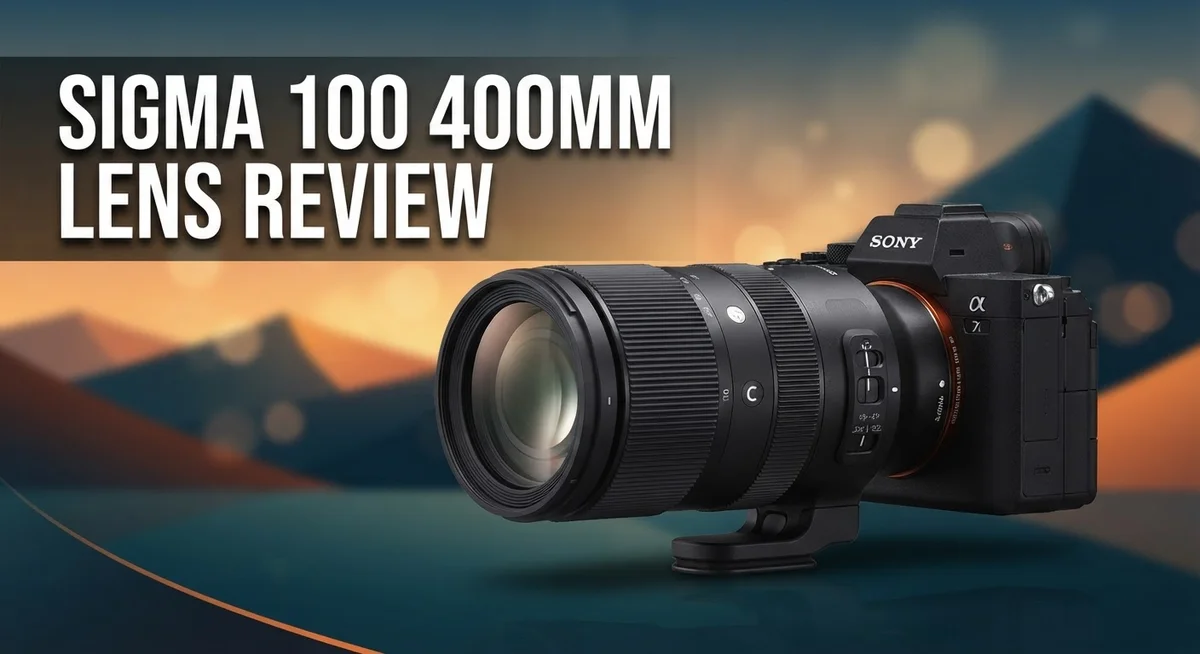
Sigma 100-400mm f/5-6.3 DG DN OS Contemporary Lens Review
Looking for a telephoto zoom that actually keeps up with you? The Sigma 100-400mm f/5-6.3 DG DN OS Contemporary might be your answer.
This lens covers a huge zoom range. It stretches from 100mm all the way to 400mm. That means you get flexibility for wildlife, sports, and even landscapes.
Build quality stands out right away. The lens feels solid in your hands, yet stays light enough for long shoots. Its smooth zoom ring makes framing shots simple and quick.
Sharpness impresses across the range too. Many photographers praise its landscape performance especially.
Does it handle low light well? Not quite. The variable aperture limits performance once the sun goes down.
Still, this lens offers strong value for telephoto fans. Let’s break down what makes it tick, and where it falls short.
In a Nutshell
Here’s a quick rundown of what makes this lens worth a look:
- Weather sealed design protects your gear from dust and light rain during outdoor shoots.
- The AF Function Setting switch and focus limiter help you lock onto subjects faster, especially for wildlife or sports.
- A 9-blade rounded diaphragm creates smooth, pleasing background blur for your shots.
- At 100mm, you get 1:4.1 magnification for decent close-up detail on smaller subjects.
- This lens fits both Sony E and L-mount systems, giving you flexibility across mirrorless bodies.
- Some users notice light fall-off at certain focal lengths, so edge brightness may need minor adjustment.
- The zoom ring feels stiff out of the box but loosens up nicely after regular use.
- Compared to the Sony 100-400mm and Canon RF 100-400mm, this Sigma holds its own in build and reach.
If you want a telephoto that balances portability with practical features, this lens checks most boxes. It’s not perfect for every scenario, but it handles everyday telephoto needs well.
Optical Performance and Sharpness
The Sigma 100-400mm delivers impressive sharpness across its entire focal range. You get crisp detail whether you shoot at 100mm or push to 400mm. This consistency makes the lens reliable for landscapes, wildlife, and distant subjects.
Edge-to-edge clarity stands out as a real strength. The center performs exceptionally well, and sharpness holds up even at the wider aperture settings. You won’t feel limited when cropping tight shots in post-production.
Contrast and color rendition are naturally vibrant. The lens renders colors accurately without excessive processing. Scenes look clean and punchy right from the camera.
One area to watch is light fall-off at the longer focal lengths. You may notice the image corners appear slightly darker than the center, especially at 400mm. This is manageable and rarely ruins shots, but it’s worth knowing about before you shoot.
The variable aperture (f/5-6.3) affects performance in low-light situations. At 100mm, f/5 gives you decent light gathering. By 400mm, the aperture narrows to f/6.3, which reduces shutter speed options when you need it most. Indoor or evening shoots may require higher ISO or a tripod to maintain sharp results.
Autofocus speed pairs well with the optical quality. The lens focuses smoothly and quietly, which helps you nail focus on moving subjects. The focus limiter switch lets you restrict the focusing range, speeding up acquisition when you don’t need the full distance spectrum.
Chromatic aberration remains minimal across the zoom range. You won’t spot obvious color fringing on high-contrast edges, even in challenging lighting. This speaks to solid optical design.
The Sigma 100-400mm shines brightest in daylight and good weather conditions. Landscapes, birds, and distant events all benefit from the sharp rendering. You trade some low-light capability for a compact telephoto that delivers solid image quality without dragging you down in the field.

- INCLUDED - Sigma 100-400mm Lens, Lens Cap, Rear Cap, Lens Hood, Protective Cover, 67mm Filter Kit, Software Kit, Lens...
- SUPERB IMAGE QUALITY - Experience exceptional sharpness and clarity across the entire zoom range, capturing intricate...
- VERSATILE FOCAL LENGTH - The 100-400mm range offers incredible flexibility, perfect for wildlife, sports, and portraits...
Last update on 2026-10-06 / Affiliate links / Images from Amazon Product Advertising API
Build Quality and Weather Sealing
The Sigma 100-400mm feels solid in your hands from the moment you pick it up. The barrel construction uses quality materials that resist flex and wobble during extended shooting sessions. The zoom ring turns smoothly without grinding sounds or resistance issues, though some users report initial stiffness that loosens with use.
Weather sealing on this lens gives you real protection. Sigma applies rubber gaskets around the barrel and at connection points. You can shoot in light rain or dusty conditions without constant worry about internal damage. The sealed design keeps moisture and particles away from optical elements. This feature matters most if you shoot outdoors frequently or in unpredictable weather.
The lens mount itself feels robust and well machined. Connection to your camera body is secure, with no play or rattling. The focus ring has a smooth, precise feel that responds well to both manual and autofocus adjustments. The AF Function Setting switch sits conveniently on the barrel for quick access without removing your eye from the viewfinder.
Internal construction shows attention to detail. The 9-blade diaphragm operates quietly and smoothly. Optical elements are carefully aligned to maintain sharpness across the entire zoom range. The focus mechanism responds quickly without audible grinding or lag.
One area to monitor is the zoom ring’s grip. Extended use in cold weather can make the rubber coating less responsive. Regular cleaning keeps it functioning smoothly. The focus limiter switch works well for locking onto subjects in specific distance ranges, reducing hunting time during critical moments.
Overall build quality matches what you’d expect from a contemporary telephoto zoom. The lens feels like a professional tool without excessive weight or bulk. Durability appears solid based on user reports. The weather sealing provides genuine protection for outdoor work. These qualities combine to create a lens that handles daily shooting demands reliably. The construction inspires confidence when you’re working in challenging conditions or demanding situations.
Autofocus and Optical Stabilization
The autofocus system on the Sigma 100-400mm keeps up well with fast-moving subjects. You get smooth, reliable tracking that pairs nicely with the optical quality throughout the zoom range.
The AF Function Setting switch gives you real control over how the lens behaves. You can customize focus behavior to match your shooting style, whether you’re chasing wildlife or tracking moving objects. This flexibility helps you lock onto subjects faster without fumbling through menus.
The focus limiter feature deserves attention too. This switch lets you restrict the focus range, which speeds up autofocus performance when you know your subject distance. For wildlife or sports, this means less hunting time and more keeper shots.
Minimum focus distances are practical across the range. At 100mm, you focus down to 3.6 feet, giving you decent close-up detail. At 400mm, the minimum focus distance extends to 5.2 feet, which is typical for telephoto lenses at that focal length.
The optical stabilization (OS) system handles camera shake effectively. You’ll notice the difference when shooting handheld at longer focal lengths or in slightly dimmer conditions. The stabilization works quietly in the background without drawing attention to itself.
One thing to keep in mind: the slow variable aperture (f/5-6.3) means optical stabilization becomes more important in low-light situations. The OS system compensates for this limitation, but it’s not a complete fix. Daylight shooting remains this lens’s sweet spot.
The stabilization integrates seamlessly with mirrorless camera bodies. Whether you’re on Sony E-mount or L-mount, the OS system works consistently. You won’t experience lag or hunting behavior during stabilization operation.
Overall, the autofocus and stabilization systems work together smoothly. The AF responds quickly to subject movement, while the OS keeps your handheld shots sharp. These features combine to make the 100-400mm a practical choice for handheld telephoto work across various shooting conditions.
Top 3 Alternatives
Canon EF 100-400mm

- Items Include : 1 x Canon EF 100-400mm f/4.5-5.6L IS II USM Lens, 1 x 77mm 3 Piece Filter Kit, 1 x Lens Cap Keeper, 1 x...
- A long-reaching telephoto zoom characterized by a sophisticated optical design and advanced image stabilization...
- Benefitting the optical components of the lens, a four-stop effective Image Stabilizer helps to minimize the appearance...
Last update on 2026-10-06 / Affiliate links / Images from Amazon Product Advertising API
The Canon EF 100-400mm offers excellent reach for wildlife and sports photography. This lens delivers sharp images across its entire zoom range. You get fast autofocus performance that tracks moving subjects well. The optical image stabilization helps you shoot handheld at longer focal lengths.
The build quality feels solid and professional. Weather sealing protects your lens from dust and moisture. Many photographers appreciate the smooth zoom ring and focus ring. The lens performs especially well in good lighting conditions.
Nikon AF-S 80-400mm

- Bundle Items Include: 1 x Nikon - AF-S NIKKOR 80-400mm f/4.5-5.6G ED VR Telephoto Zoom Lens, 1 x 3 Piece Filter Kit, 1 x...
- Combining the functionality of multiple telephoto lenses into a single, user-friendly zoom, the Nikon AF-S NIKKOR...
- To further enhance optical performance, the lens is equipped with both Nano Crystal and Super Integrated Coatings. These...
Last update on 2026-10-06 / Affiliate links / Images from Amazon Product Advertising API
Nikon’s AF-S 80-400mm is a popular choice among Nikon users seeking versatility. This lens starts at 80mm, giving you extra wide coverage compared to some alternatives. The autofocus system works reliably for both stills and video.
Vibration reduction helps you capture steady shots without a tripod. The lens feels comfortable to hold during extended shooting sessions. Image quality remains consistent throughout the zoom range. Many photographers praise its balance between performance and practicality.
Tamron SP 100-400mm

- Highly portable, ultra-telephoto zoom lens with AF precision
- 3 LD (Low Dispersion) glass elements
- eBAND (Extended Bandwidth & Angular-Dependency) Coating
Last update on 2026-10-06 / Affiliate links / Images from Amazon Product Advertising API
Tamron’s SP 100-400mm brings excellent optical performance to the telephoto zoom category. This lens features fast and accurate autofocus that works across multiple camera systems. The vibration compensation system keeps your images sharp.
The design prioritizes both weight and handling comfort. You’ll notice the smooth operation of the zoom mechanism. Optical quality remains high even at maximum zoom. The lens handles various lighting situations admirably. Many users report satisfaction with the overall value this lens provides for their photography needs.
Versatility Across Focal Lengths
The Sigma 100-400mm excels when you need flexibility across different shooting scenarios. The 100mm starting point opens doors for portrait work and medium-range subjects. You get natural compression and flattering subject isolation at this focal length.
As you zoom toward 400mm, the lens transforms into a powerful tool for wildlife and distant subjects. The telephoto reach lets you frame subjects tightly without moving closer. This capability matters when you photograph skittish animals or events from fixed positions.
The variable aperture (f/5-6.3) shifts as you zoom. At 100mm, you get f/5 for better light gathering. By 400mm, the aperture narrows to f/6.3, which requires adjustment in your shooting approach. Understanding this trade-off helps you plan your shots before you press the shutter.
The minimum focus distances stay practical throughout the range. At 100mm, you focus as close as 3.6 feet. At 400mm, the minimum focus extends to 5.2 feet. These distances let you work comfortably without excessive back-and-forth movement.
The 9-blade rounded diaphragm creates smooth bokeh when you want background separation. The magnification ratio of 1:4.1 gives you macro-like capabilities for close-range detail work. This means you can capture small subjects with surprising clarity.
The focus limiter switch deserves mention here. You can restrict autofocus to specific distance ranges, which speeds up focusing in situations where you know your subject distance. This feature proves useful during fast-paced shooting.
The zoom ring operates smoothly once broken in. Initial stiffness gives way to fluid operation with regular use. The ring’s position on the barrel feels natural for most hand sizes.
Weather sealing throughout the lens barrel means you shoot confidently in challenging conditions. Rain, dust, and moisture don’t penetrate the internal mechanisms. This durability extends the lens lifespan and keeps performance consistent.
The optical stabilization system compensates for camera shake across the entire zoom range. You can hand-hold at slower shutter speeds than the variable aperture might otherwise allow. This stabilization becomes especially valuable at 400mm where magnification amplifies any movement.
Together, these features create a lens that adapts to your shooting needs. Whether you’re framing portraits, capturing wildlife, or shooting distant landscapes, the Sigma 100-400mm responds to your creative vision.
Low-Light Performance and Aperture Limitations
The variable aperture of f/5-6.3 presents the main challenge for low-light shooting. At 100mm, you get f/5, which is manageable. At 400mm, the aperture narrows to f/6.3, letting in significantly less light.
This aperture limitation becomes obvious when you shoot indoors or during golden hour. Your camera needs higher ISO values or slower shutter speeds to maintain proper exposure. The trade-off is increased noise or potential motion blur if you’re not careful.
The optical stabilization system helps compensate for this limitation. It gives you roughly 3 to 4 stops of shake correction, which extends your handheld shooting range. In low-light conditions, this stabilization becomes your best friend. You can use slower shutter speeds without introducing camera shake.
However, stabilization cannot replace the light that a wider aperture provides. It cannot help with subject movement or fast-moving wildlife in dim settings. If your subject moves quickly, you still need adequate light to freeze motion.
The 9-blade rounded diaphragm does create smooth bokeh separation when conditions allow. Background blur appears natural and pleasing. This helps your subject stand out even when shooting at maximum aperture.
For indoor sports, concerts, or dimly lit events, this lens requires more patience and planning. You might need fast film speeds or fast shutter speeds. A tripod becomes valuable in these situations.
The lens performs adequately in twilight conditions with the stabilization engaged. You gain flexibility that a non-stabilized telephoto cannot offer. Still, expect to push your camera’s ISO higher than you might with a faster lens.
Low-light portraiture remains difficult with this lens. The slow aperture limits your ability to isolate subjects with shallow depth of field. Outdoor portraits work well in bright conditions. Indoor portraits demand creative lighting solutions.
The Sigma 100-400mm works best when light is available. Plan your shoots accordingly, and you’ll appreciate what this lens delivers. The stabilization system and rounded diaphragm help maximize its potential in challenging light.
Pros and Cons
Pros
- Compact and lightweight design delivers serious 100-400mm reach without bulk
- Sharp image quality shines in landscape photography and distant subjects
- Smooth zoom ring and solid build quality feel professional in your hands
- Versatile 100mm focal length works surprisingly well for portraits
- Weather sealing lets you shoot confidently in rain and dusty conditions
- Optical stabilization compensates effectively for camera shake
Cons
- Slow variable aperture (f/5-6.3) struggles in low light and indoor settings
- Significant light fall-off reported at the edges, especially at 400mm
- Initial stiffness in the zoom ring requires a break-in period
- X-mount version cannot accept teleconverters for extended reach
Who Should Buy It
Wildlife photographers benefit most from this lens. You get a 400mm reach that pulls distant subjects close. The optical stabilization helps you hand-hold shots in challenging field conditions. The compact size means you carry less weight during long shooting days.
Sports photographers find real value here too. You can track fast-moving action across a field or stadium. The autofocus function setting switch lets you customize tracking behavior for your style. Just remember the variable aperture means you need faster shutter speeds in overcast conditions.
Landscape and travel photographers should seriously consider this option. The 100mm starting point gives you flexibility for wider scenic shots. You zoom to 400mm for distant mountains or architectural details. The weather sealing protects your investment when you shoot in rain or dusty environments.
Professional videographers appreciate the smooth zoom ring once broken in. The optical stabilization reduces jitter during panning shots. The focus limiter switch prevents hunting when you need quick, reliable focus pulls. This makes it practical for documentary work and event coverage.
Hobbyist photographers who want serious reach without complexity find this lens approachable. You get professional build quality and sharp optics. The 100mm versatility means you shoot everything from portraits to distant subjects with one lens. The intuitive controls feel natural after a few outings.
Portrait shooters should know this isn’t ideal for that specialty. The variable aperture limits background separation compared to dedicated portrait lenses. If your primary focus is portraiture, look elsewhere.
Low-light event photographers need caution here. The f/5-6.3 aperture struggles indoors or at concerts. You’ll need higher ISO values and potentially slower shutter speeds. If you regularly shoot in dim venues, a faster telephoto serves you better.
Photographers on mirrorless systems with Sony E or L-mount get a native option. You avoid adapter complications. The lens communicates directly with your camera body for optimal performance. This matters for autofocus speed and stabilization coordination.
Basically, this lens shines for outdoor shooting, wildlife work, and travel photography. It works well for sports in daylight. It struggles only when you need fast apertures or shoot predominantly indoors.
Final Verdict
The Sigma 100-400mm f/5-6.3 DG DN OS Contemporary earns its place as a smart telephoto choice. It balances reach, portability, and sharpness without overwhelming your camera bag.
This lens stands out against rivals like the Sony 100-400mm and Canon RF 100-400mm. Those native options often weigh more and feel bulkier in hand.
Tamron alternatives offer similar focal ranges too. But Sigma’s build quality and zoom smoothness give it a slight edge once the ring breaks in.
One detail worth noting: the X-mount version does not work with teleconverters. Fujifilm shooters who want extra reach should keep this in mind before buying.
The minimum focus distance of 3.6 feet at 100mm and 5.2 feet at 400mm adds flexibility. You can capture closer details on distant wildlife or isolate small objects in nature shots.
With a 1:4.1 magnification ratio, this lens won’t replace a dedicated macro lens. But it handles close-up shots better than most telephoto zooms in this class.
So who should buy this lens? Outdoor photographers, wildlife enthusiasts, and travel shooters will get the most value from this glass. The reach and portability fit those genres perfectly.
Portrait specialists and low-light event shooters should look elsewhere. The variable aperture and light fall-off create real limitations for those specific needs.
If you shoot on Sony E or L-mount mirrorless systems, this lens deserves serious consideration. It delivers professional results without demanding a heavy investment in extra gear or bulk.
Overall, this Sigma lens proves that smart engineering beats brute specs. It won’t win every battle against pricier native lenses. But for everyday outdoor photography, it holds its own with confidence.
Buyers who understand its strengths and limits will walk away satisfied. This lens rewards photographers who match their expectations to its actual capabilities.
Frequently Asked Questions
Can I use this lens for portrait photography?
The Sigma 100-400mm works at 100mm for portraits, but it’s not the ideal choice. The variable aperture (f/5-6.3) makes it hard to blur the background the way portrait photographers love. You’ll get decent sharpness, yet the shallow depth of field you want becomes difficult to achieve.
If portraits are your main focus, consider a dedicated portrait lens instead. This zoom shines more for landscapes and wildlife.
Does the optical stabilization really help?
Yes, the OS (optical stabilization) performs well for handheld shooting. You can shoot at slower shutter speeds without blur, which helps in outdoor conditions with changing light.
However, don’t rely on it alone in very dim environments. The slow aperture means you still need decent light to get sharp shots. The stabilization works best outdoors during daytime or golden hour.
What’s the minimum focus distance, and does it matter?
At 100mm, you focus as close as 3.6 feet. At 400mm, the minimum distance is 5.2 feet. This gives you flexibility for subjects that aren’t too far away.
For wildlife, this matters less since animals stay distant. For travel and landscape work, the close focus adds versatility without needing a separate macro lens.
Will this lens work with teleconverters?
On Sony E and L-mount cameras, yes. On the X-mount version, no. The X-mount design doesn’t support teleconverters, so check your camera system before buying.
If you plan to extend your reach with a 1.4x or 2x converter, confirm compatibility first.
How does it compare to the Sony 100-400mm?
Both lenses cover the same focal range. The Sony version is native to Sony cameras, so autofocus integration feels seamless. The Sigma offers similar optical performance and stabilization.
Your choice depends on mount system and personal preference. Both are solid options for serious telephoto work.

Kashvi is a passionate bird enthusiast and nature lover who has been fascinated by the world of birds for years. With a keen eye for detail and a love for learning, Kashvi is dedicated to sharing her knowledge and insights with fellow bird enthusiasts on Avian Enthusiasts. Through her engaging and informative articles, Kashvi aims to inspire others to join her in exploring the fascinating world of birds and to promote a deeper appreciation for these incredible creatures.