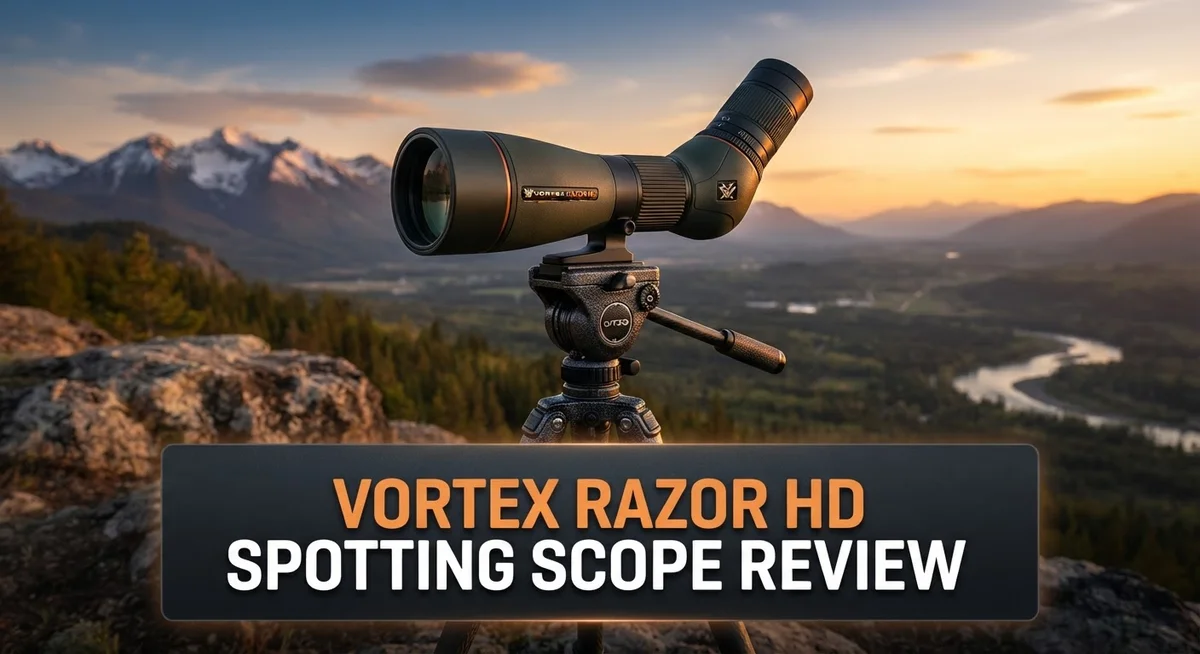
Vortex Razor HD Spotting Scope Review: Performance, Optics, and Value
Looking for a spotting scope that performs well in the field? The Vortex Razor HD might be the answer.
This scope comes in three models. You can pick 22-48×65, 13-39×56, or 20-60×85. Each one brings a different balance of size and power.
Vortex built these scopes with a dielectric coated Porro prism. They also added XR multi coated optics. This combo gives you a bright and sharp image from edge to edge.
Color fidelity stands out in this lineup too. Even in low light, the Razor HD holds its clarity. Hunters and birders both notice the difference.
The wide field of view makes tracking moving targets easy. Whether you chase game or scan distant ridges, this scope keeps up.
Let’s break down what makes the Razor HD worth your attention.
In a Nutshell
Here’s the quick rundown on the Vortex Razor HD spotting scope.
-
Sharp optics shine in this scope. You get a bright, clear image from edge to edge, even in low light conditions.
-
The 85mm model gives you stronger magnification than the 65mm version. Pick the size that fits your hunting or birding needs.
-
Watch for a slight magenta tint in certain lighting. Some users notice this color shift during testing.
-
The helical focuser works well but moves slower than some rival scopes. Patience helps when fine tuning your focus.
-
This scope cannot support prime focus mode. Digiscoping fans should keep this limitation in mind before buying.
-
Compared to the Leupold SX-4 and Vortex Viper HD, the Razor HD holds its own. It competes well against top names in optics.
-
Overall, this scope delivers strong image quality and a solid build. It suits serious outdoor enthusiasts who want dependable performance.
Optical Performance and Image Quality
The Razor HD delivers exceptional optical performance that stands out in field conditions. You get a bright, sharp image across the entire viewing area, which matters when you’re scanning distant terrain or wildlife.
Color accuracy is a real strength here. The scope reproduces natural colors without heavy distortion, and this quality becomes even more obvious when light fades. Low light performance is genuinely impressive for a scope in this class. The XR multi coated optics work hard to push light through to your eye, so you see more detail when conditions get tough.
The dielectric coated Porro prism keeps internal reflections minimal. This means less light loss and better contrast overall. You notice the difference when comparing side by side with older prism designs.
Field of view ranges from 56 to 77 degrees depending on magnification. This wide viewing area makes it easier to locate targets and track movement without constantly adjusting your position. Smooth panning becomes natural rather than frustrating.
One thing to watch for is a subtle magenta color bias in certain lighting situations. It’s not severe, but some users notice it more than others. This won’t ruin your experience, but it’s worth knowing about before you commit.
Image clarity remains consistent from edge to edge. You don’t get the typical softness that creeps in at the edges of cheaper scopes. Every part of your field of view stays sharp and usable.
The helical focuser works smoothly, though it turns slower than some competitor models. This means fine tuning takes a bit longer, but you gain precision in return. Fast focus isn’t always better if it sacrifices accuracy.
The 85mm objective lens option gives you stronger magnification power compared to the 65mm version. This extra glass means more light gathering and better performance at high magnification levels. The 65mm stays lighter and more portable, so your choice depends on your specific needs.
Overall, the Razor HD combines sharp optics with reliable light transmission. You get a scope that performs consistently across different environments and lighting conditions.

- The Razor HD 13-39x56 Angled spotting scope is a compact, lightweight, high performance spotting scope for hunters...
- Using an HD optical system optimized with select glass elements and XR Plus lens coatings, it delivers exceptional...
- A smooth helical focus dials in razor sharp resolution and keeps the scope trim for easy packing. The removable eyepiece...
Last update on 2026-10-06 / Affiliate links / Images from Amazon Product Advertising API
Build Quality and Design
The Vortex Razor HD spotting scope features a construction that emphasizes durability and optical excellence. The body uses premium materials designed to withstand field use without compromising performance.
The scope comes in three distinct configurations. You can choose the 22-48×65 angled model, the 13-39×56 version, or the 20-60×85 option. Each model serves different hunting and observation needs.
Optical construction relies on a dielectric-coated Porro prism system. This design minimizes internal light loss and reflections. The XR multi-coated optics enhance light transmission throughout the optical path. These coatings work together to produce bright, clear images in various lighting conditions.
The physical design balances weight and stability. The 65mm objective lens offers a lighter profile, while the 85mm objective delivers increased light gathering capability. Both options maintain a comfortable handling experience in the field.
The helical focuser provides smooth operation for precise image adjustment. Focus speed moves at a deliberate pace compared to some competitor models. This slower movement gives you finer control but requires patience during quick focus adjustments.
The scope’s exterior coating resists scratches and environmental wear. The barrel design feels solid in your hands. The eyepiece rotates smoothly for comfortable viewing angles. Rubber armoring protects the optics from accidental bumps and impacts.
Internal mechanics show careful engineering. The prism sits securely within the housing. Mechanical tolerances remain tight, preventing wobble or misalignment over time. This rigidity ensures consistent optical performance after repeated use.
The angled eyepiece design on the 22-48×65 model reduces neck strain during extended viewing sessions. You can position your eye at a comfortable angle without bending awkwardly.
Build quality reflects Vortex’s reputation for reliability. The scope handles temperature fluctuations without optical degradation. Moisture sealing keeps internal surfaces dry in humid environments. The construction philosophy emphasizes longevity and consistent performance across seasons.
The overall design prioritizes optical clarity over unnecessary features. Every component serves a functional purpose. This straightforward approach results in a scope that performs reliably in demanding field conditions without unnecessary complexity.
Magnification and Field of View
When you look through the Vortex Razor HD, magnification and field of view work together to give you a complete viewing experience. The scope offers three different configurations to match your specific needs.
The 22-48x magnification on the 65mm model gives you flexibility for both wide scanning and tight zoom work. You get a field of view that ranges from 56 to 77 degrees depending on which magnification level you choose. This wide viewing angle helps you locate targets faster without constantly panning around.
The 13-39×56 model sits in the middle ground. It balances magnification power with a generous field of view. This setup works well if you want solid zoom capability without sacrificing your ability to see a broad area at once.
The 20-60×85 model delivers the strongest magnification performance. The larger 85mm objective lens captures more light and allows for stronger zoom levels than the 65mm option. This means distant targets appear closer and clearer. The tradeoff is that the field of view narrows slightly at maximum magnification, which is normal for spotting scopes.
One practical detail: the magnification range affects how steady your view feels. At higher magnification, even small hand movements become noticeable. A tripod becomes essential at maximum zoom levels.
The dielectric coated Porro prism keeps images bright across the entire magnification range. You won’t see significant darkening as you zoom in. Edge-to-edge sharpness remains consistent, so targets stay clear whether they’re dead center or toward the edges of your view.
The helical focuser lets you dial in precise focus at any magnification. It moves smoothly, though it requires more turns than some competitor models. This slower focusing speed actually helps prevent overshooting your focus point, especially at high magnification where focus is critical.
If you plan to use this scope with a camera for digiscoping, remember that it cannot operate in prime focus mode. This limitation matters if that’s part of your intended use.
Top 3 Alternatives
Leupold Gold Ring Spotting Scope

- GR 12-40x60mm HD Shadow Gray
- Spotting Scope, Telescopes & Accessories
- Optics
Last update on 2026-10-06 / Affiliate links / Images from Amazon Product Advertising API
The Leupold Gold Ring delivers exceptional optical clarity for hunters and shooters. This scope features premium glass that reduces glare and enhances contrast in various lighting conditions. You get a wide field of view that makes tracking moving targets easier.
The build quality feels solid and reliable. Many users appreciate the straightforward focus mechanism. The scope handles rough conditions without losing performance. It’s a practical choice for serious outdoor enthusiasts who want dependable optics without unnecessary complexity.
Swarovski ATS Spotting Scope

- SUPERIOR CLARITY - Experience unmatched image quality with the 80mm objective lens, gathering ample light for bright...
- VERSATILE MAGNIFICATION - Adjust from 20x to 60x with the zoom eyepiece, allowing detailed observation of distant...
- WIDE FIELD OF VIEW - Enjoy a broad visual range (118-66 ft/1000 yds), perfect for tracking moving objects or surveying...
Last update on 2026-09-11 / Affiliate links / Images from Amazon Product Advertising API
Swarovski brings Swiss precision to spotting scope design. The ATS model offers stunning image brightness and color accuracy. You’ll notice fine details even in low light situations. The glass coatings work hard to minimize reflections and maximize light transmission.
The scope feels premium in your hands. Durability stands out as a major strength. The focusing ring operates smoothly, giving you quick adjustments. Swarovski includes thoughtful features like protective caps and a solid carrying case. This scope appeals to users who value Austrian engineering and optical excellence.
Zeiss Victory Spotting Scope

- ELABORATE LENS SYSTEM - FL glass and other custom glass ensure an absolutely sharp and colour fidelity image even at...
- COMFORTVISION CONCEPT - Subjective 72-degree angle of vision over the entire zoom range for a noticeably greater...
- DUALSPEED FOCUS - Precise focussing with automatic switching between rapid and fine adjustment.
Last update on 2026-10-06 / Affiliate links / Images from Amazon Product Advertising API
Zeiss Victory combines German optical engineering with modern functionality. The scope delivers crisp, clear images across its entire field of view. You get excellent color reproduction that makes identifying distant objects simple and accurate.
The mechanical design emphasizes reliability and precision. The Victory performs exceptionally well in bright sunlight and overcast conditions alike. The eyepiece focuses smoothly without grinding or resistance. Zeiss backs this scope with strong warranty support. Users consistently report confidence in the Victory’s performance during extended outdoor sessions. The scope suits both casual observers and professional applications where optical quality matters most.
Low-Light Performance and Color Accuracy
Low light situations test any spotting scope. The Vortex Razor HD handles this challenge well. Its XR multi-coated optics allow more light to pass through the barrel, which means brighter images when the sun dips low.
The dielectric-coated Porro prism plays a key role here. This coating reduces light loss at every glass surface inside the scope. You see more detail in shadows and overcast conditions than you would with standard prism designs.
Color accuracy remains strong even as light fades. The scope delivers true greens, browns, and earth tones without washing them out. This matters when you’re glassing hillsides for wildlife or scanning distant terrain.
One observation worth noting: a subtle magenta tint appears in certain low light angles. This doesn’t destroy the image, but you’ll notice it if you’re comparing side by side with other premium scopes. It’s minor and won’t affect your ability to spot game or scan landscapes.
The 85mm objective lens option performs better than the 65mm in dim conditions. The larger lens gathers more light, so you get clearer views during dawn and dusk. If low light performance tops your priority list, the 85mm version makes sense.
Magnification affects low light performance too. Higher magnifications gather less light per unit area, so you might see dimmer images at 48x or 60x compared to lower settings. The scope handles this trade off reasonably well, but you’ll notice the difference in very poor light.
The helical focuser lets you dial in sharp focus even when light is poor. You can make micro adjustments to find that sweet spot. This precision helps you extract maximum detail from whatever light is available.
Overall, the Vortex Razor HD performs admirably in low light. It won’t match dedicated night vision equipment, but it delivers solid performance during twilight hours and overcast days. The combination of good light transmission, accurate colors, and precise focus control makes it reliable when conditions turn dim.
Focusing Mechanism and Usability
The focusing mechanism on the Vortex Razor HD uses a helical focuser design. This system lets you rotate a dial to adjust focus smoothly across the entire magnification range. The motion feels natural and responsive under your fingers.
One key advantage of the helical focuser is precision. You can dial in sharp focus at any magnification level without hunting for the sweet spot. This matters when you’re scanning at high zoom and need critical sharpness instantly.
However, the helical focuser operates slower than some competitor models. If you frequently shift between distant and close subjects, you’ll notice the adjustment requires more rotations than push-pull focus systems. This trade-off favors precision over speed, which suits stationary viewing better than mobile scanning.
The focus throw distance is generous. A full rotation of the dial moves focus significantly, giving you fine control without tiny, frustrating adjustments. This design reduces hand fatigue during long viewing sessions.
Usability improves with practice. New users sometimes expect faster focus changes. After a few hours of use, most observers adapt to the helical rhythm and appreciate the repeatability it offers. The dial sits in a comfortable position for right-handed operation.
The angled eyepiece on the 22-48×65 model affects how you position your hands during focusing. Your arm angle changes compared to straight-tube designs. Some shooters find this more comfortable for extended periods. Others prefer the straight-tube layout of the 20-60×85 model.
The focus range extends from close distances to infinity. You won’t struggle getting sharp focus on nearby subjects or distant landscapes. The internal mechanics handle this full range without grinding or resistance.
One practical note: the helical focuser requires a lighter touch than some competitors. Applying excessive pressure doesn’t speed up focus. Instead, it reduces control and can overshoot your target focus point. Smooth, deliberate movements work best.
Overall, the focusing mechanism prioritizes accuracy and reliability over rapid adjustment. This philosophy fits the scope’s purpose as a premium observation tool for serious users who value image quality above all else.
Pros and Cons
Pros
- Sharp, bright images from edge to edge across all magnification settings
- Excellent color reproduction that holds strong even in dim lighting conditions
- Wide field of view ranging from 56 to 77 degrees for easy target acquisition
- The 85mm objective lens model delivers superior low light performance compared to the 65mm version
- Dielectric coated Porro prism maintains image quality throughout the entire magnification range
Cons
- A subtle magenta color tint appears in certain low light angles during extended viewing sessions
- Helical focuser operates slower than many competing spotting scope models on the market
- Cannot function in prime focus mode, which limits digiscoping and camera attachment options
- Helical focuser requires a lighter touch than competitor designs to avoid excessive pressure buildup
Who Should Buy It
The Vortex Razor HD spotting scope fits several types of users perfectly.
Long range hunters benefit most from this scope. You need sharp images at distance, and the Razor HD delivers edge to edge clarity across all magnification settings. The 85mm model gives you stronger magnification for spotting game at extreme distances. The wide field of view makes target acquisition faster when you’re glassing hillsides or open terrain.
Serious birdwatchers will appreciate the color accuracy and low light performance. Birds often appear during dawn or dusk when light fades quickly. The dielectric coated Porro prism maintains image quality in these challenging conditions. You get true color reproduction that helps with species identification, even as shadows lengthen.
Competitive shooters who practice at long range courses should consider this model. You need reliable focus adjustments between shots, and the helical focuser gives you precision control. The generous focus throw distance lets you make fine adjustments without rushing. Extended viewing sessions won’t strain your eyes thanks to the bright, sharp optics.
Tactical and law enforcement users often choose the Razor HD for surveillance work. The 65mm angled model works well in confined spaces where you need a compact setup. The helical focuser requires a lighter touch than some competitors, so you can make quiet adjustments without drawing attention.
Wildlife photographers scouting locations find value in the optical quality. You can preview scenes before setting up camera equipment. The wide field of view helps you plan compositions and identify the best vantage points.
Casual spotting scope users should know this scope demands some learning time. The helical focuser operates slower than many competitors, so expect a brief adjustment period. New users sometimes expect instant focus changes, but practice makes the process natural.
The Razor HD suits anyone who prioritizes image brightness and color fidelity over speed. If you spend hours glassing terrain or observing wildlife, the optical clarity pays dividends. You’ll notice the difference compared to entry level models.
Final Verdict
The Vortex Razor HD earns its place among top spotting scopes. It delivers clear optical performance that rivals pricier European brands.
When you compare it to the Leupold SX-4, the Razor HD holds its own in brightness and color accuracy. Both scopes perform well, but the Razor HD edges ahead in low light situations.
If you already own a Vortex Viper HD or Diamondback, you might wonder if the upgrade makes sense. The Razor HD offers noticeably better glass quality and sharper edge-to-edge clarity.
That said, this scope is not for everyone. Users who need instant digiscoping setups may find the lack of prime focus mode frustrating.
Think about your main use case before you decide. Hunters and birdwatchers who value image quality will love this scope.
Tactical users and competitive shooters also benefit from the precise focus system, even though it takes time to master.
Casual users might feel the learning curve is steep. If you want a grab-and-go scope with instant focus, other models may suit you better.
The Razor HD rewards patience. Once you learn the helical focuser, you unlock a level of control that many scopes cannot match.
Compared to unnamed European competitors, Vortex still holds strong advantages. You get similar optical clarity along with better customer support and warranty options.
This scope works best for people who plan to use it often. Regular practice helps you master the focus system quickly.
For serious outdoor enthusiasts, the Razor HD stands out as a smart long term choice. It performs well across hunting, birdwatching, and tactical scenarios.
In short, this spotting scope suits users who prioritize image quality above speed. If that matches your needs, the Razor HD will not disappoint you.
Choose this scope if you want dependable, sharp optics for years of outdoor use. It remains a strong contender in its class.
Frequently Asked Questions
Does the Razor HD work well for digiscoping with cameras?
No, this scope cannot operate in “prime focus” mode. That means you’ll face some limits when attaching cameras for digiscoping. The optical design prioritizes eyepiece viewing over camera coupling. If digiscoping is your main goal, you may want to explore other options first.
How does the 85mm model compare to the 65mm version?
The 85mm objective lens delivers stronger magnification and superior low light performance. You get more light gathering power, which helps in dim conditions. The 65mm stays lighter and easier to transport. Choose the 85mm if low light work matters most to you.
Is the focus system fast enough for quick target acquisition?
The helical focuser operates slower than many competing models. This means you’ll need extra time to lock onto moving targets. However, the slow focus encourages precision and reduces overshooting. Patient users appreciate the control it offers.
What color shift should I expect during extended viewing?
A subtle magenta tint appears in certain low light angles. This happens most during long sessions in dim conditions. The tint is mild and does not affect overall image quality significantly. Most users adapt quickly and barely notice it after a few minutes.
Who gets the most value from this scope?
Long range hunters, serious birdwatchers, and tactical users benefit most. Wildlife photographers scouting locations find the optical quality excellent. Casual spotters should expect a learning curve. This scope rewards patience and rewards users who prioritize brightness and color accuracy above all else.

Kashvi is a passionate bird enthusiast and nature lover who has been fascinated by the world of birds for years. With a keen eye for detail and a love for learning, Kashvi is dedicated to sharing her knowledge and insights with fellow bird enthusiasts on Avian Enthusiasts. Through her engaging and informative articles, Kashvi aims to inspire others to join her in exploring the fascinating world of birds and to promote a deeper appreciation for these incredible creatures.